Word Explanation
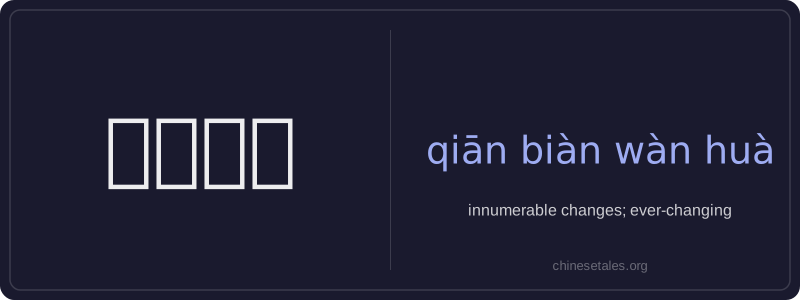
‘千变万化’ literally means ‘a thousand changes and ten thousand transformations,’ using the classical Chinese numbers 千 (thousand) and 万 (ten thousand) hyperbolically to express boundlessness. The characters 变 (biàn, ‘to change’) and 化 (huà, ‘to transform; to metamorphose’) reinforce the idea of dynamic, unpredictable, and often profound alteration. Together, the idiom conveys a state or process of constant, intricate, and seemingly endless variation.
This expression is commonly used to describe natural phenomena (like weather, animal camouflage, or seasonal landscapes), artistic styles, technological developments, or human behavior—especially when emphasizing complexity and fluidity. It carries a neutral-to-positive connotation, often evoking awe or admiration for adaptability and diversity. Though it functions grammatically as both a noun and an adjective, it typically modifies nouns or serves as a predicate complement (e.g., ‘情况千变万化’ — ‘the situation is ever-changing’).
Example Sentences
Related Words
见面
见面 literally means 'see face' — combining 见 (t
背后
背后 literally means 'back + behind' and functions
中学
'Zhōngxué' literally combines 'zhōng' (middle)
面条
‘面条’ (miàn tiáo) literally means ‘flour str
后来
Later (hòulái) is an adverb meaning 'afterwards'
我的
我的 (wǒ de) is a possessive pronoun meaning 'my'
这么
这么 (zhè me) is an adverb meaning 'so' or 'this
前面
前面 (qián miàn) literally combines 前 (qián, '