Word Explanation
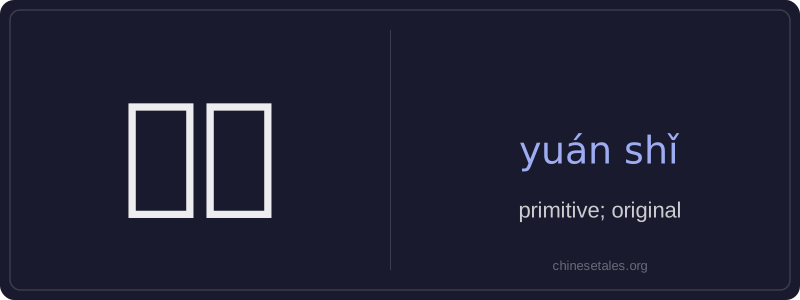
'原始' (yuán shǐ) is an adjective meaning 'primitive' or 'original', describing something in its earliest, most basic, or undeveloped state. The character 原 (yuán) means 'origin', 'source', or 'original', while 始 (shǐ) means 'beginning' or 'to start'. Together, they emphasize the very first stage of existence or development — before refinement, modernization, or human intervention. It often carries a neutral or slightly academic tone and appears frequently in scientific, historical, or anthropological contexts.
This word commonly modifies nouns like 社会 (shèhuì, 'society'), 文明 (wénmíng, 'civilization'), 森林 (sēnlín, 'forest'), or 动物 (dòngwù, 'animal'). For example, 原始社会 refers to 'prehistoric society', and 原始森林 means 'primeval forest' — untouched, ancient woodland. Unlike 古老 (gǔlǎo, 'ancient'), which stresses age alone, 原始 stresses simplicity, lack of development, and closeness to origins.
Example Sentences
Related Words
见面
见面 literally means 'see face' — combining 见 (t
背后
背后 literally means 'back + behind' and functions
中学
'Zhōngxué' literally combines 'zhōng' (middle)
面条
‘面条’ (miàn tiáo) literally means ‘flour str
后来
Later (hòulái) is an adverb meaning 'afterwards'
我的
我的 (wǒ de) is a possessive pronoun meaning 'my'
这么
这么 (zhè me) is an adverb meaning 'so' or 'this
前面
前面 (qián miàn) literally combines 前 (qián, '