Word Explanation
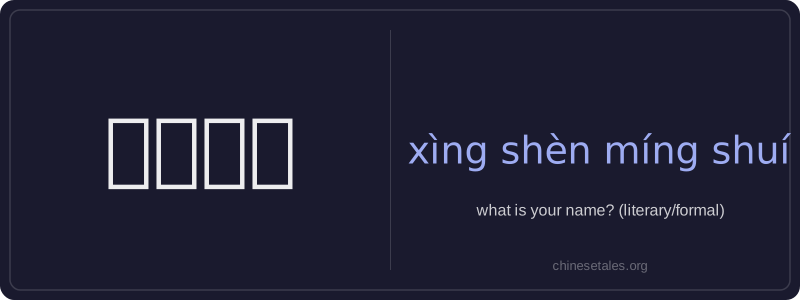
'Xìng shèn míng shuí' is a formal, literary expression meaning 'What is your name?' It literally breaks down as 姓 (xìng, 'surname'), 甚 (shèn, archaic for 'what'), 名 (míng, 'given name'), and 谁 (shuí, 'who'). Together, it asks for both family and given names in a polite, traditional way—common in classical texts, historical dramas, official documents, or ceremonial introductions.
This phrase reflects classical Chinese syntax, where word order is inverted compared to modern spoken Chinese ('Nǐ jiào shénme míngzi?'). It carries respectful distance and gravitas, rarely used in casual conversation among peers. While grammatically a question phrase, it functions as a fixed four-character idiom (chéngyǔ-like) rather than a compositional sentence—and is never used with auxiliary verbs or tense markers. Learners should note that 谁 here is pronounced shuí (not shéi) in formal literary contexts.
Example Sentences
Related Words
见面
见面 literally means 'see face' — combining 见 (t
背后
背后 literally means 'back + behind' and functions
中学
'Zhōngxué' literally combines 'zhōng' (middle)
面条
‘面条’ (miàn tiáo) literally means ‘flour str
后来
Later (hòulái) is an adverb meaning 'afterwards'
我的
我的 (wǒ de) is a possessive pronoun meaning 'my'
这么
这么 (zhè me) is an adverb meaning 'so' or 'this
前面
前面 (qián miàn) literally combines 前 (qián, '