Word Explanation
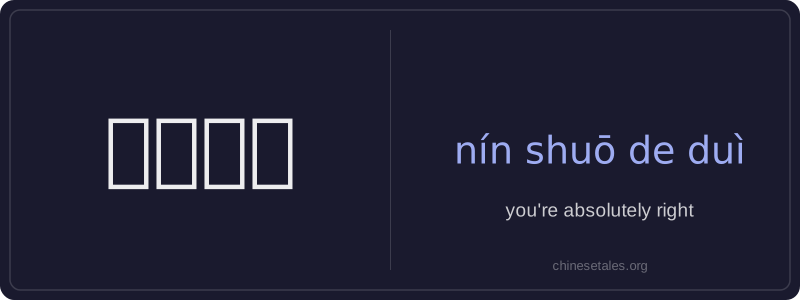
‘您说得对’ is a polite, respectful expression meaning ‘you’re absolutely right’ or ‘you’re completely correct.’ It combines the honorific second-person pronoun 您 (nín), the verb 说 (shuō, ‘to say’), the structural particle 得 (de) that introduces a complement of degree or result, and the adjective 对 (duì, ‘correct’). Together, they literally mean ‘you say [in such a way that it is] correct,’ conveying full agreement with emphasis on the speaker’s accuracy and authority.
This phrase is commonly used in formal or respectful conversations — for example, when agreeing with a teacher, elder, client, or superior. It signals humility, attentiveness, and deference, making it especially appropriate in professional, academic, or intergenerational settings. Unlike the more casual ‘你说得对’ (using 你), the use of 您 immediately elevates the tone and shows sincere respect.
Example Sentences
Related Words
见面
见面 literally means 'see face' — combining 见 (t
背后
背后 literally means 'back + behind' and functions
中学
'Zhōngxué' literally combines 'zhōng' (middle)
面条
‘面条’ (miàn tiáo) literally means ‘flour str
后来
Later (hòulái) is an adverb meaning 'afterwards'
我的
我的 (wǒ de) is a possessive pronoun meaning 'my'
这么
这么 (zhè me) is an adverb meaning 'so' or 'this
前面
前面 (qián miàn) literally combines 前 (qián, '