Word Explanation
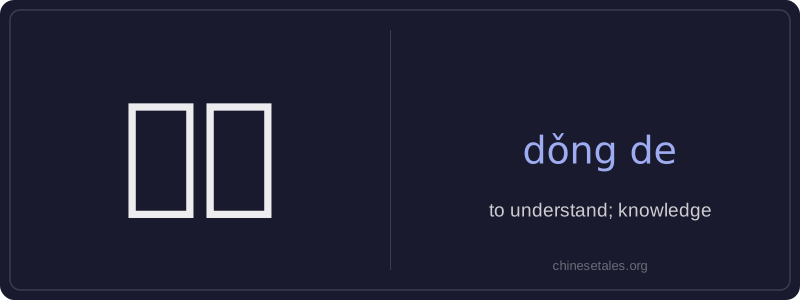
懂得 (dǒng de) is a verb meaning 'to understand' or 'to know how to do something.' It combines the character 懂 (dǒng), which means 'to comprehend' or 'to grasp mentally,' and the particle 得 (de), which here functions as a structural complement marker indicating capability or acquired knowledge — not to be confused with the other homophone 得 (dé, 'to obtain') or 得 (děi, 'must'). Unlike the simple verb 懂, 懂得 emphasizes a deeper, more practiced or conscious understanding, often implying familiarity through experience or study.
This word is commonly used in everyday speech and writing when referring to knowledge of skills, rules, languages, social norms, or abstract concepts. It frequently appears after subjects like 我, 他, or 孩子 and before nouns (e.g., 懂得礼貌) or verbs in their bare form (e.g., 懂得开车). It carries a slightly more formal or reflective tone than 懂 alone and is rarely used in commands or questions without auxiliary support.
Example Sentences
Related Words
见面
见面 literally means 'see face' — combining 见 (t
背后
背后 literally means 'back + behind' and functions
中学
'Zhōngxué' literally combines 'zhōng' (middle)
面条
‘面条’ (miàn tiáo) literally means ‘flour str
后来
Later (hòulái) is an adverb meaning 'afterwards'
我的
我的 (wǒ de) is a possessive pronoun meaning 'my'
这么
这么 (zhè me) is an adverb meaning 'so' or 'this
前面
前面 (qián miàn) literally combines 前 (qián, '