Word Explanation
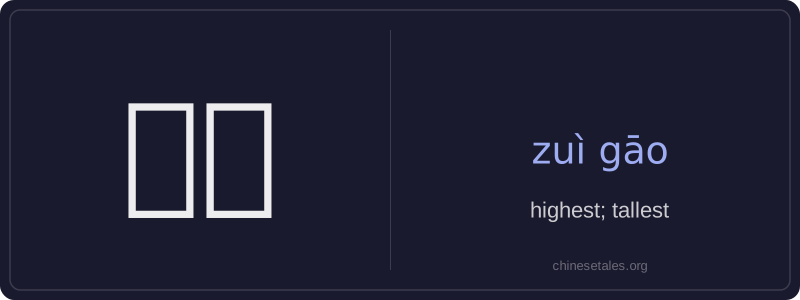
最高 (zuì gāo) is an adjective meaning 'highest' or 'tallest', formed by combining 最 (zuì), the superlative marker meaning 'most', and 高 (gāo), meaning 'high' or 'tall'. Together, they express the absolute highest degree in a measurable dimension—such as elevation, rank, temperature, or status. It functions like English comparatives ending in '-est' but requires no additional particles; it directly modifies nouns (e.g., 最高温度, 'highest temperature') or stands alone as a predicate (e.g., 这座山最高, 'This mountain is the tallest').
It’s commonly used in geography (mountains, buildings), statistics (records, scores), social hierarchy (highest position), and science (maximum values). Unlike English, 最高 cannot be used attributively before a noun without a structural particle like 的 when the noun is definite or emphasized—but in everyday speech, 的 is often omitted before monosyllabic nouns (e.g., 最高奖 vs. 最高奖项). It’s neutral in register and appears in both formal reports and casual conversation.
Example Sentences
Related Words
见面
见面 literally means 'see face' — combining 见 (t
背后
背后 literally means 'back + behind' and functions
中学
'Zhōngxué' literally combines 'zhōng' (middle)
面条
‘面条’ (miàn tiáo) literally means ‘flour str
后来
Later (hòulái) is an adverb meaning 'afterwards'
我的
我的 (wǒ de) is a possessive pronoun meaning 'my'
在家
'Zài jiā' literally combines the preposition 'z
不对
不对 (bù duì) literally combines 不 (bù), meani