Word Explanation
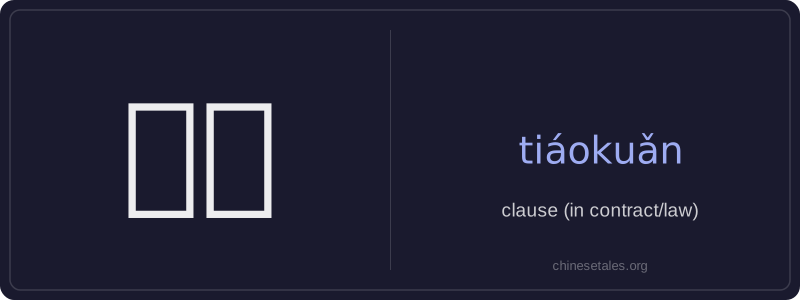
‘条款’ (tiáokuǎn) is a formal noun meaning ‘clause’—a distinct, numbered provision within legal documents such as contracts, statutes, or regulations. The character 条 (tiáo) literally means ‘item’, ‘article’, or ‘strip’, and often functions as a classifier for long, linear things; 款 (kuǎn) means ‘provision’, ‘section’, or ‘stipulation’, emphasizing content and intent. Together, they form a compound that denotes an individual, self-contained unit of obligation, right, or condition in written agreements.
This word appears almost exclusively in formal, written contexts—especially law, business, and official administration—and is rarely used in casual speech. It carries a tone of precision and authority: each 条款 is binding, subject to interpretation, and often referenced by number (e.g., ‘第5条’). Unlike general terms like 规定 (guīdìng, ‘rule’) or 条例 (tiáolì, ‘regulation’), 条款 specifically refers to subdivisions *within* a larger document, not standalone laws.
Example Sentences
Related Words
见面
见面 literally means 'see face' — combining 见 (t
背后
背后 literally means 'back + behind' and functions
中学
'Zhōngxué' literally combines 'zhōng' (middle)
面条
‘面条’ (miàn tiáo) literally means ‘flour str
后来
Later (hòulái) is an adverb meaning 'afterwards'
我的
我的 (wǒ de) is a possessive pronoun meaning 'my'
在家
'Zài jiā' literally combines the preposition 'z
不对
不对 (bù duì) literally combines 不 (bù), meani