Word Explanation
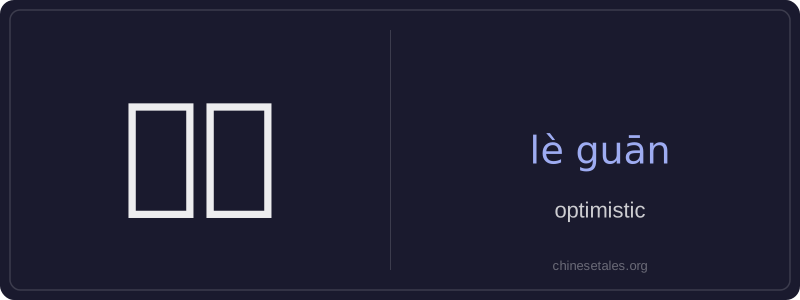
‘乐观’ (lè guān) is an adjective meaning 'optimistic' — describing a person who tends to expect positive outcomes, maintain hope in difficult situations, and focus on solutions rather than problems. The character 乐 (lè) means 'joy' or 'pleasure', while 观 (guān) means 'to view' or 'perspective'. Together, they literally suggest 'a joyful perspective' or 'viewing things with joy'. This word reflects an enduring mindset, not just a fleeting mood.
It’s commonly used to describe personality traits, attitudes toward challenges (e.g., illness, setbacks, or uncertainty), and interpersonal impressions ('He’s very 乐观'). Unlike the verb 观 (guān) in other compounds, here it functions as part of a fixed two-character adjective — it cannot be separated or modified by degree adverbs like 很 without context (e.g., 很乐观 is acceptable, but *很观 is impossible). It frequently appears in both spoken and written Chinese, especially in self-descriptions, psychological discussions, and news reports about resilience.
Example Sentences
Related Words
见面
见面 literally means 'see face' — combining 见 (t
背后
背后 literally means 'back + behind' and functions
我的
我的 (wǒ de) is a possessive pronoun meaning 'my'
中学
'Zhōngxué' literally combines 'zhōng' (middle)
面条
‘面条’ (miàn tiáo) literally means ‘flour str
后来
Later (hòulái) is an adverb meaning 'afterwards'
在家
'Zài jiā' literally combines the preposition 'z
不对
不对 (bù duì) literally combines 不 (bù), meani