Word Explanation
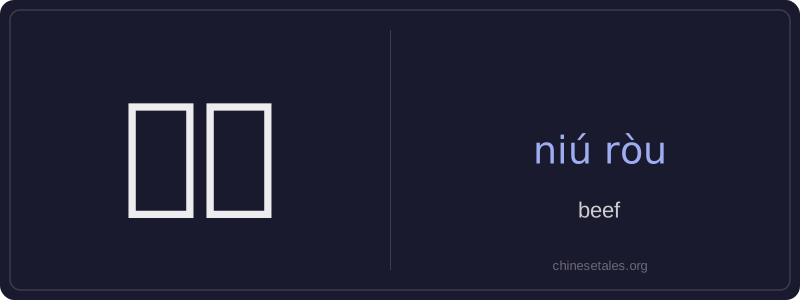
‘Niú ròu’ literally means ‘cow meat’ and refers to beef—the edible muscle tissue of cattle. The first character, 牛 (niú), means ‘cow’ or ‘cattle’, while 肉 (ròu) means ‘meat’ in general. Together, they form a compound noun specifying the source animal, following a common Chinese pattern for naming meats (e.g., 猪肉 zhūròu ‘pork’, 羊肉 yángròu ‘lamb’). Unlike English, where ‘beef’ is a distinct lexical item unrelated to ‘cow’, Chinese compounds like this are transparent and productive.
This word is used in everyday contexts—from grocery shopping and restaurant menus to cooking instructions and dietary discussions. It appears in both formal and informal speech, and is neutral in register. While 牛 can refer to bulls, cows, or oxen depending on context, 牛肉 always denotes the meat itself, not the live animal. It’s commonly modified by adjectives (e.g., 新鲜的牛肉 ‘fresh beef’) or quantifiers (e.g., 一斤牛肉 ‘a jin of beef’).
Example Sentences
Related Words
见面
见面 literally means 'see face' — combining 见 (t
背后
背后 literally means 'back + behind' and functions
我的
我的 (wǒ de) is a possessive pronoun meaning 'my'
中学
'Zhōngxué' literally combines 'zhōng' (middle)
面条
‘面条’ (miàn tiáo) literally means ‘flour str
后来
Later (hòulái) is an adverb meaning 'afterwards'
在家
'Zài jiā' literally combines the preposition 'z
不对
不对 (bù duì) literally combines 不 (bù), meani