Word Explanation
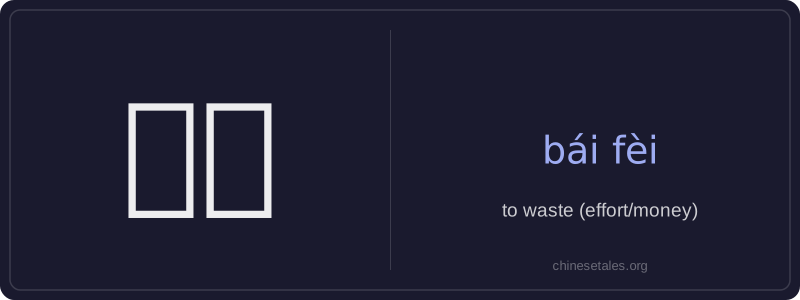
‘白费’ is a verb meaning 'to waste' — specifically, to expend effort, time, or money without achieving the desired result. The character 白 (bái) literally means 'white' but here functions as an adverb meaning 'in vain' or 'for nothing'; 费 (fèi) means 'to spend' or 'expense'. Together, they form an inseparable compound expressing futile expenditure. It’s commonly used with nouns like 功夫 (gōngfu, effort), 时间 (shíjiān, time), or 钱 (qián, money), and often appears in negative or regretful contexts.
This word carries a tone of disappointment or criticism — for example, someone might say it to point out that another person’s hard work yielded no benefit. It’s frequently found in spoken Mandarin and informal writing, but rarely in formal or technical registers. Unlike standalone verbs, 白费 is almost always followed by a noun object and never used transitively without one — you cannot say *‘他白费了’ alone; it must be ‘他白费了力气’ or similar.
Example Sentences
Related Words
见面
见面 literally means 'see face' — combining 见 (t
背后
背后 literally means 'back + behind' and functions
我的
我的 (wǒ de) is a possessive pronoun meaning 'my'
中学
'Zhōngxué' literally combines 'zhōng' (middle)
面条
‘面条’ (miàn tiáo) literally means ‘flour str
后来
Later (hòulái) is an adverb meaning 'afterwards'
在家
'Zài jiā' literally combines the preposition 'z
不对
不对 (bù duì) literally combines 不 (bù), meani