Word Explanation
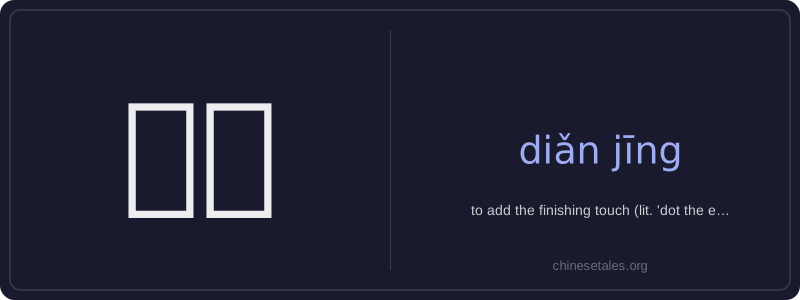
‘点睛’ literally means ‘to dot the eye’ and originates from an ancient Chinese legend about a painter who brought painted dragons to life by adding eyes to them. The idiom now metaphorically refers to adding a crucial, final detail that transforms or completes something—giving it vitality, clarity, or impact. While the characters individually mean ‘dot’ (点) and ‘eye’ (睛, specifically the eyeball), together they function as a set phrase emphasizing the power of a small but decisive action.
This expression is commonly used in artistic, literary, academic, and even business contexts to praise a subtle yet transformative contribution—such as a concluding sentence in an essay, a strategic tweak in a design, or a well-placed comment in a presentation. It carries a positive, appreciative tone and often implies wisdom, insight, or mastery. Though rooted in classical allusion, it remains widely understood and used in modern Standard Mandarin, especially in formal or refined speech and writing.
Example Sentences
Related Words
见面
见面 literally means 'see face' — combining 见 (t
背后
背后 literally means 'back + behind' and functions
我的
我的 (wǒ de) is a possessive pronoun meaning 'my'
中学
'Zhōngxué' literally combines 'zhōng' (middle)
面条
‘面条’ (miàn tiáo) literally means ‘flour str
后来
Later (hòulái) is an adverb meaning 'afterwards'
在家
'Zài jiā' literally combines the preposition 'z
不对
不对 (bù duì) literally combines 不 (bù), meani