Word Explanation
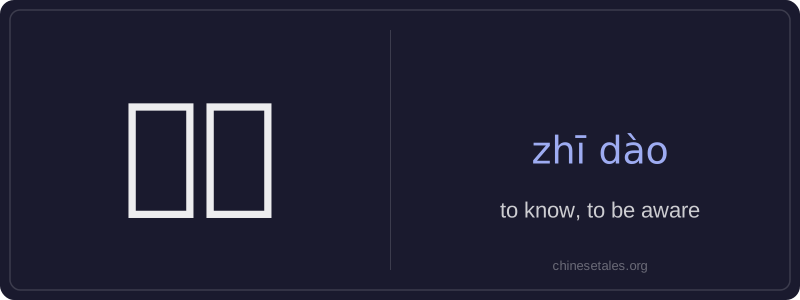
知道 (zhī dào) is a common verb meaning 'to know' or 'to be aware of' something — typically facts, information, or situations. It combines 知 (zhī), meaning 'to know' or 'to perceive', and 道 (dào), which here functions as a complement indicating realization or understanding — not the philosophical 'Dao'. Unlike the standalone verb 知 (rare in modern speech), 知道 is fully grammaticalized and used in everyday spoken and written Chinese.
This word emphasizes having mental awareness or recognition, not necessarily deep knowledge or expertise. It’s often used in questions ('Do you know...?'), statements about personal awareness ('I know that...'), or to express sudden realization ('Oh, I see!'). It frequently appears with complements like 吗 (for yes/no questions), 了 (to indicate newly acquired knowledge), or objects introduced by 的 (e.g., 我知道他是谁). It does not take aspectual particles like 着 or 过 in standard usage.
Example Sentences
Related Words
见面
见面 literally means 'see face' — combining 见 (t
背后
背后 literally means 'back + behind' and functions
我的
我的 (wǒ de) is a possessive pronoun meaning 'my'
中学
'Zhōngxué' literally combines 'zhōng' (middle)
面条
‘面条’ (miàn tiáo) literally means ‘flour str
后来
Later (hòulái) is an adverb meaning 'afterwards'
在家
'Zài jiā' literally combines the preposition 'z
不对
不对 (bù duì) literally combines 不 (bù), meani