Word Explanation
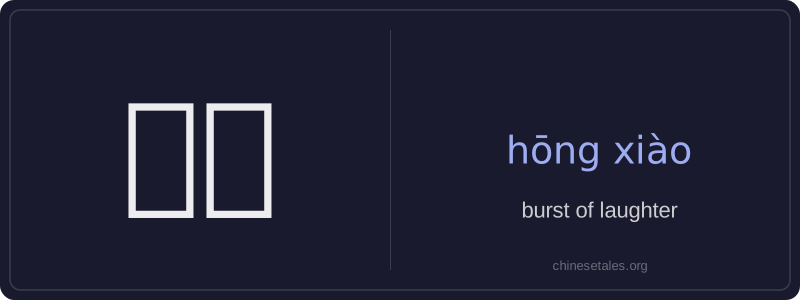
‘哄笑’ refers to a sudden, collective burst of laughter—often loud, spontaneous, and shared by a group of people. The first character 哄 (hōng) conveys a sense of noise or commotion (as in 哄闹 hōngnào, ‘to make a racket’), while 笑 (xiào) means ‘to laugh’. Together, they emphasize the volume and social nature of the laughter—not just smiling or chuckling, but an audible, often contagious outburst that fills a room or crowd.
This word is commonly used in descriptive writing, journalism, and storytelling to capture moments of shared amusement, especially when something unexpected, ironic, or mildly embarrassing happens. It carries a neutral-to-lightly positive tone, though context can shade it toward teasing or gentle mockery. Unlike individual laughter (e.g., 笑, 大笑), 哄笑 inherently implies multiple people reacting simultaneously—and usually audibly—to the same stimulus.
Example Sentences
Related Words
见面
见面 literally means 'see face' — combining 见 (t
背后
背后 literally means 'back + behind' and functions
我的
我的 (wǒ de) is a possessive pronoun meaning 'my'
中学
'Zhōngxué' literally combines 'zhōng' (middle)
面条
‘面条’ (miàn tiáo) literally means ‘flour str
后来
Later (hòulái) is an adverb meaning 'afterwards'
在家
'Zài jiā' literally combines the preposition 'z
不对
不对 (bù duì) literally combines 不 (bù), meani