Word Explanation
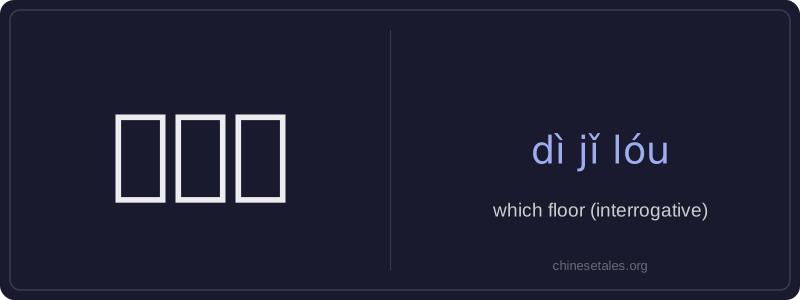
'Dì jǐ lóu' literally means 'the which floor' and functions as an interrogative noun phrase meaning 'which floor?' in English. It combines the ordinal prefix 第 (dì), the interrogative numeral 几 (jǐ, meaning 'how many' or 'which' in counting contexts), and 楼 (lóu, meaning 'floor' or 'story' of a building). Unlike English, Chinese uses this fixed structure to ask about floor numbers — you cannot say *'jǐ lóu' alone in formal or standard questions for location; 'dì jǐ lóu' is the grammatically required form when seeking a specific floor number in a building.
This phrase is commonly used in daily interactions such as asking for directions in malls, apartments, or office buildings. It always appears in questions — never as a statement — and typically follows question words like 'nǎ lǐ' (where) or 'zài' (at), or appears directly as the subject/object of a question. Tone is important: 'jǐ' must carry the third tone, distinguishing it from 'jī' (first tone, meaning 'machine') or 'jì' (fourth tone, meaning 'to record').
Example Sentences
Related Words
见面
见面 literally means 'see face' — combining 见 (t
背后
背后 literally means 'back + behind' and functions
我的
我的 (wǒ de) is a possessive pronoun meaning 'my'
中学
'Zhōngxué' literally combines 'zhōng' (middle)
面条
‘面条’ (miàn tiáo) literally means ‘flour str
后来
Later (hòulái) is an adverb meaning 'afterwards'
在家
'Zài jiā' literally combines the preposition 'z
不对
不对 (bù duì) literally combines 不 (bù), meani