Word Explanation
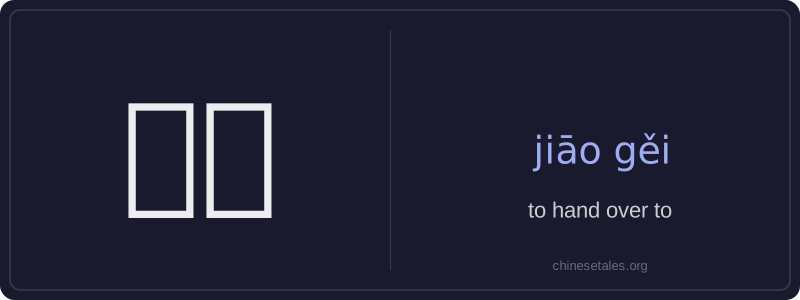
'交给' (jiāo gěi) is a compound verb meaning 'to hand over to', 'to entrust to', or 'to pass something to someone'. It combines two characters: 交 (jiāo), meaning 'to hand over', 'to deliver', or 'to interact', and 给 (gěi), meaning 'to give' or 'to provide'. Together, they emphasize the directional transfer of an object, responsibility, or task from one party to another. Unlike the simple verb 给, 交给 explicitly marks the recipient and implies formal or intentional transfer—often involving documents, duties, items, or authority.
This verb is commonly used in work, administrative, educational, or daily-life contexts where delegation or assignment occurs. It typically follows a subject–object–verb structure, with the object placed before 交给 and the recipient marked by a noun or pronoun after it (e.g., 把文件交给老师). It can also appear without 把 in neutral statements (e.g., 我把钥匙交给了他). The action implies completion and responsibility shift—not just giving, but assigning or surrendering control.
Example Sentences
Related Words
见面
见面 literally means 'see face' — combining 见 (t
背后
背后 literally means 'back + behind' and functions
我的
我的 (wǒ de) is a possessive pronoun meaning 'my'
中学
'Zhōngxué' literally combines 'zhōng' (middle)
面条
‘面条’ (miàn tiáo) literally means ‘flour str
后来
Later (hòulái) is an adverb meaning 'afterwards'
在家
'Zài jiā' literally combines the preposition 'z
不对
不对 (bù duì) literally combines 不 (bù), meani