Word Explanation
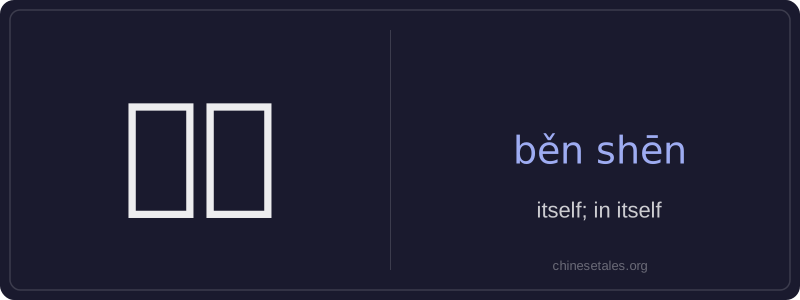
Běnshēn literally combines běn (‘origin,’ ‘root,’ or ‘base’) and shēn (‘body,’ ‘self’), together conveying the idea of ‘the thing itself’ — emphasizing intrinsic nature, not external factors or associations. It functions as a reflexive pronoun or adverb to stress that something is being considered in its own right, without reference to context, cause, or consequence.
This word appears frequently in formal writing, academic discussion, and careful speech — for example, when distinguishing between an object’s inherent qualities versus how it’s used or perceived. It often follows the noun it modifies (e.g., 问题本身, ‘the problem itself’) and can be placed after verbs to mean ‘in itself’ (e.g., 并不难,本身很简单, ‘It’s not difficult — simple in itself’). Unlike English ‘itself,’ běnshēn cannot stand alone as a subject; it always depends on a preceding noun or clause.
Example Sentences
Related Words
见面
见面 literally means 'see face' — combining 见 (t
背后
背后 literally means 'back + behind' and functions
我的
我的 (wǒ de) is a possessive pronoun meaning 'my'
中学
'Zhōngxué' literally combines 'zhōng' (middle)
面条
‘面条’ (miàn tiáo) literally means ‘flour str
后来
Later (hòulái) is an adverb meaning 'afterwards'
在家
'Zài jiā' literally combines the preposition 'z
不对
不对 (bù duì) literally combines 不 (bù), meani