Word Explanation
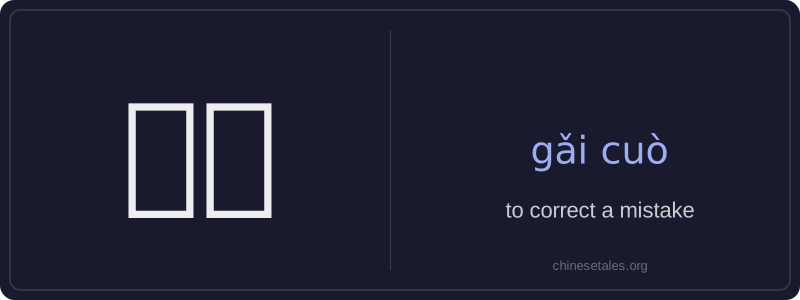
‘Gǎi cuò’ literally means ‘to change (gǎi) a mistake (cuò)’, and functions as a verb meaning ‘to correct a mistake’ or ‘to fix an error’. The character 改 conveys the idea of altering, modifying, or rectifying something already existing, while 错 refers specifically to an error, fault, or inaccuracy — whether in writing, speech, calculation, or behavior. Together, they form a common, action-oriented compound used especially in educational, professional, and everyday contexts where accuracy matters.
This verb is frequently used in classroom settings (e.g., teachers asking students to gǎi cuò after a test), language learning (correcting grammar or spelling errors), and office work (revising documents or data). It implies an intentional, often step-by-step process of identifying and then fixing the error — not merely deleting it, but replacing it with the right version. While it can be used transitively (e.g., gǎi cuò wénzhāng — ‘correct the article’), it’s also commonly used without an explicit object when the context makes the error clear.
Example Sentences
Related Words
见面
见面 literally means 'see face' — combining 见 (t
背后
背后 literally means 'back + behind' and functions
我的
我的 (wǒ de) is a possessive pronoun meaning 'my'
中学
'Zhōngxué' literally combines 'zhōng' (middle)
面条
‘面条’ (miàn tiáo) literally means ‘flour str
后来
Later (hòulái) is an adverb meaning 'afterwards'
在家
'Zài jiā' literally combines the preposition 'z
不对
不对 (bù duì) literally combines 不 (bù), meani