Word Explanation
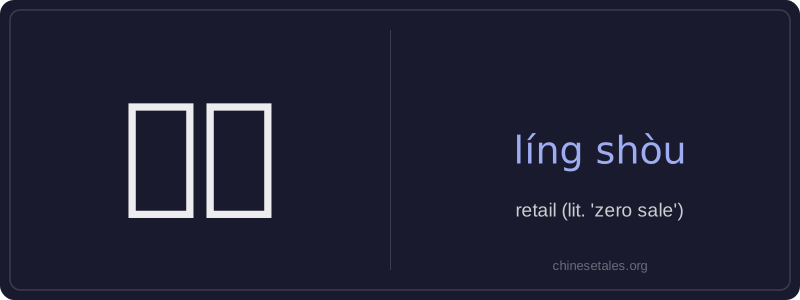
'Retail' refers to the sale of goods or services directly to end consumers, typically in small quantities. The term 零售 literally breaks down as 零 (líng), meaning 'zero' or 'fragmentary', and 售 (shòu), meaning 'to sell'. Together, they convey the idea of selling individual items or 'in pieces'—as opposed to wholesale (批发), which involves bulk sales to businesses. This word is commonly used in business, economics, and everyday commerce contexts.
You’ll encounter 零售 in signs (e.g., 零售商店 'retail store'), news reports about consumer spending, and job titles (e.g., 零售经理 'retail manager'). It functions primarily as a noun but can also act attributively before other nouns (e.g., 零售业 'retail industry'). Unlike verbs, it doesn’t take aspect particles like 了 or 过, and it’s rarely used alone without a modifier or context—it usually appears in compound terms or phrases describing channels, models, or sectors.
Example Sentences
Related Words
见面
见面 literally means 'see face' — combining 见 (t
背后
背后 literally means 'back + behind' and functions
我的
我的 (wǒ de) is a possessive pronoun meaning 'my'
中学
'Zhōngxué' literally combines 'zhōng' (middle)
面条
‘面条’ (miàn tiáo) literally means ‘flour str
后来
Later (hòulái) is an adverb meaning 'afterwards'
在家
'Zài jiā' literally combines the preposition 'z
不对
不对 (bù duì) literally combines 不 (bù), meani