Word Explanation
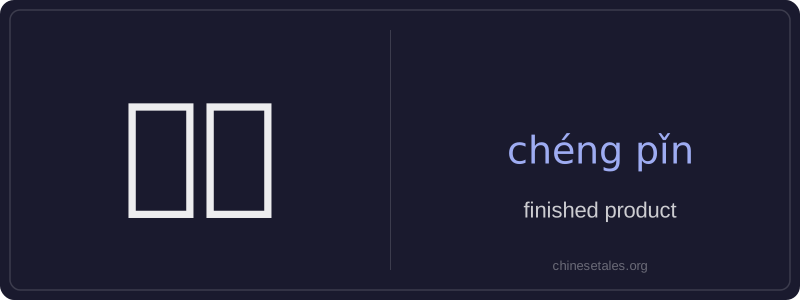
'成品' (chéng pǐn) literally combines '成' (chéng), meaning 'completed' or 'accomplished', and '品' (pǐn), meaning 'item', 'product', or 'article'. Together, they form a compound noun meaning 'finished product' — something that has gone through all necessary manufacturing, assembly, or processing steps and is ready for sale, use, or distribution. It contrasts with raw materials (原材料, yuán cáiliào) or semi-finished goods (半成品, bàn chéng pǐn).
This term is widely used in industrial, commercial, and quality-control contexts — for example, when discussing production lines, inventory management, or product inspections. While it can refer to physical goods like electronics or furniture, it’s also applied to non-tangible outputs such as software releases or published books, as long as they represent a completed, deliverable stage. It carries a neutral, formal register and appears frequently in business reports, factory signage, and technical documentation.
Example Sentences
Related Words
见面
见面 literally means 'see face' — combining 见 (t
背后
背后 literally means 'back + behind' and functions
我的
我的 (wǒ de) is a possessive pronoun meaning 'my'
中学
'Zhōngxué' literally combines 'zhōng' (middle)
面条
‘面条’ (miàn tiáo) literally means ‘flour str
后来
Later (hòulái) is an adverb meaning 'afterwards'
在家
'Zài jiā' literally combines the preposition 'z
不对
不对 (bù duì) literally combines 不 (bù), meani