Word Explanation
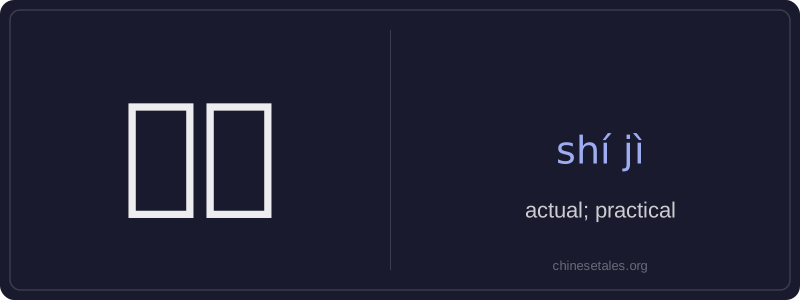
‘实际’ (shí jì) is an adjective meaning ‘actual,’ ‘real,’ or ‘practical.’ It combines the characters 实 (shí), meaning ‘true,’ ‘genuine,’ or ‘substantial,’ and 际 (jì), which often conveys ‘boundary,’ ‘scope,’ or ‘realm’ — together suggesting ‘the realm of reality’ or ‘what truly exists in practice.’
The word emphasizes concrete facts over theory, assumptions, or ideals. It’s commonly used to contrast what is real versus what is expected, imagined, or proposed — for example, discussing actual outcomes versus plans, or practical solutions versus abstract ideas. It frequently appears before nouns (e.g., 实际情况, ‘actual situation’) or after verbs like 是 or 有 (e.g., 这不符合实际情况, ‘This doesn’t match the actual situation’). While it can function as a noun in formal contexts (e.g., ‘in practice’), its primary role for learners is adjectival.
Example Sentences
Related Words
见面
见面 literally means 'see face' — combining 见 (t
背后
背后 literally means 'back + behind' and functions
我的
我的 (wǒ de) is a possessive pronoun meaning 'my'
中学
'Zhōngxué' literally combines 'zhōng' (middle)
面条
‘面条’ (miàn tiáo) literally means ‘flour str
后来
Later (hòulái) is an adverb meaning 'afterwards'
在家
'Zài jiā' literally combines the preposition 'z
不对
不对 (bù duì) literally combines 不 (bù), meani