Word Explanation
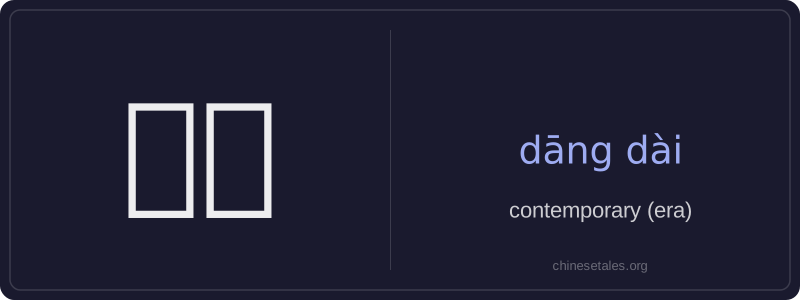
'Contemporary' refers to the present era — roughly the late 20th century to today — and functions primarily as a noun meaning 'the contemporary period' or 'contemporary times'. The character 当 (dāng) means 'present', 'current', or 'at the time of', while 代 (dài) means 'generation' or 'era'. Together, they form a compound noun denoting the current historical epoch, often used in academic, cultural, or journalistic contexts to distinguish modern developments from historical ones.
This term is commonly found in phrases like 当代文学 (contemporary literature), 当代艺术 (contemporary art), or 当代中国 (contemporary China). It carries a formal, slightly scholarly register and is rarely used in casual daily speech. Unlike the adjective 当代的 (dāngdài de), which modifies nouns directly, 当代 on its own typically appears in titles, headings, or as a subject/object in formal discourse — for example, 'This exhibition explores themes in 当代.'
Example Sentences
Related Words
见面
见面 literally means 'see face' — combining 见 (t
背后
背后 literally means 'back + behind' and functions
我的
我的 (wǒ de) is a possessive pronoun meaning 'my'
中学
'Zhōngxué' literally combines 'zhōng' (middle)
面条
‘面条’ (miàn tiáo) literally means ‘flour str
后来
Later (hòulái) is an adverb meaning 'afterwards'
在家
'Zài jiā' literally combines the preposition 'z
不对
不对 (bù duì) literally combines 不 (bù), meani