Word Explanation
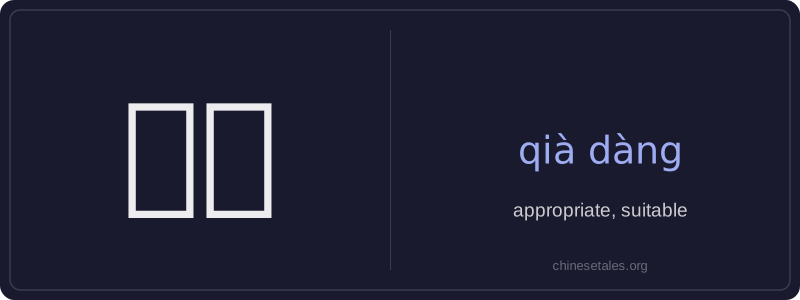
‘恰当’ is an adjective meaning 'appropriate' or 'suitable'—used to describe something that fits well with a given situation, purpose, or standard. The first character 恰 (qià) means 'just right' or 'exactly', suggesting precision; the second character 当 (dàng) means 'to match' or 'to be fitting'. Together, they emphasize correctness in degree, timing, tone, or choice—not merely adequacy, but optimal suitability. It’s commonly used in formal and semi-formal contexts: giving feedback, making recommendations, describing behavior, or evaluating decisions.
This word often modifies nouns (e.g., 恰当的方式 — 'an appropriate way') or follows verbs like 是, 显得, or 认为 (e.g., 这个回答显得很恰当 — 'This answer seems very appropriate'). It carries a neutral-to-positive connotation and implies thoughtful judgment, not just basic acceptability. Unlike colloquial alternatives like 合适, 恰当 sounds more measured and precise—frequently appearing in education, workplace communication, and written Chinese.
Example Sentences
Related Words
见面
见面 literally means 'see face' — combining 见 (t
背后
背后 literally means 'back + behind' and functions
我的
我的 (wǒ de) is a possessive pronoun meaning 'my'
中学
'Zhōngxué' literally combines 'zhōng' (middle)
面条
‘面条’ (miàn tiáo) literally means ‘flour str
后来
Later (hòulái) is an adverb meaning 'afterwards'
在家
'Zài jiā' literally combines the preposition 'z
不对
不对 (bù duì) literally combines 不 (bù), meani