Word Explanation
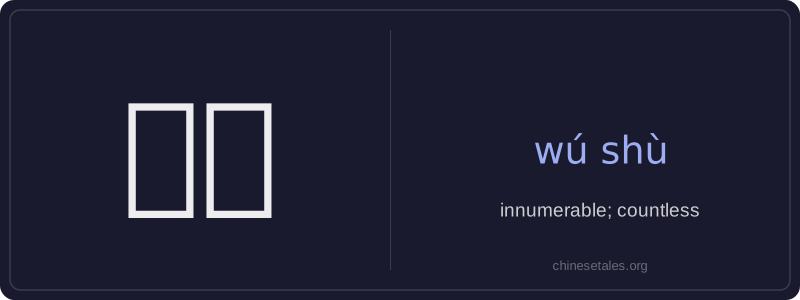
‘无数’ (wú shù) literally means ‘without number’ — combining 无 (wú, ‘without, lacking’) and 数 (shù, ‘number, count’). It functions as an adjective meaning ‘innumerable’ or ‘countless’, emphasizing such great quantity that counting is impossible or meaningless. It’s commonly used in descriptive, literary, or emphatic contexts — especially when evoking awe, scale, or abundance.
The word typically modifies nouns directly (e.g., 无数星星, countless stars) and often appears before classifiers or abstract nouns. While it conveys magnitude like English ‘infinite’ or ‘myriad’, it does not imply mathematical infinity — rather, practical uncountability due to sheer volume. It’s neutral in register but leans slightly formal or poetic, appearing frequently in nature descriptions, scientific writing, and emotional expressions (e.g., ‘无数回忆’ — countless memories).
Example Sentences
Related Words
见面
见面 literally means 'see face' — combining 见 (t
背后
背后 literally means 'back + behind' and functions
我的
我的 (wǒ de) is a possessive pronoun meaning 'my'
中学
'Zhōngxué' literally combines 'zhōng' (middle)
面条
‘面条’ (miàn tiáo) literally means ‘flour str
后来
Later (hòulái) is an adverb meaning 'afterwards'
在家
'Zài jiā' literally combines the preposition 'z
不对
不对 (bù duì) literally combines 不 (bù), meani