Word Explanation
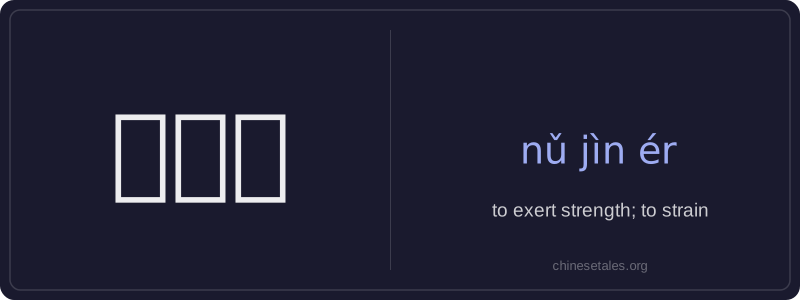
‘努劲儿’ is a colloquial verb meaning ‘to exert strength’ or ‘to strain’—often implying focused, physical or mental effort to overcome difficulty. The character 努 (nǔ) means ‘to strive’ or ‘to make an effort’, while 劲 (jìn) means ‘strength’ or ‘energy’. The suffix 儿 (ér) adds a casual, spoken tone common in Northern Mandarin dialects, especially Beijing speech. Together, they convey the idea of actively channeling one’s energy toward a goal.
This expression is frequently used in everyday situations requiring extra push—like lifting something heavy, concentrating hard on a task, or persisting through fatigue. It carries a slightly informal, vivid, and sometimes slightly humorous or empathetic nuance—never used in formal writing or speeches. Native speakers often pair it with verbs like ‘使’ (to use), ‘用’ (to apply), or ‘一’ (as in ‘一努劲儿’) to emphasize sudden or decisive effort.
Example Sentences
Related Words
背后
背后 literally means 'back + behind' and functions
见面
见面 literally means 'see face' — combining 见 (t
面条
‘面条’ (miàn tiáo) literally means ‘flour str
我的
我的 (wǒ de) is a possessive pronoun meaning 'my'
中学
'Zhōngxué' literally combines 'zhōng' (middle)
后来
Later (hòulái) is an adverb meaning 'afterwards'
在家
'Zài jiā' literally combines the preposition 'z
不对
不对 (bù duì) literally combines 不 (bù), meani