Word Explanation
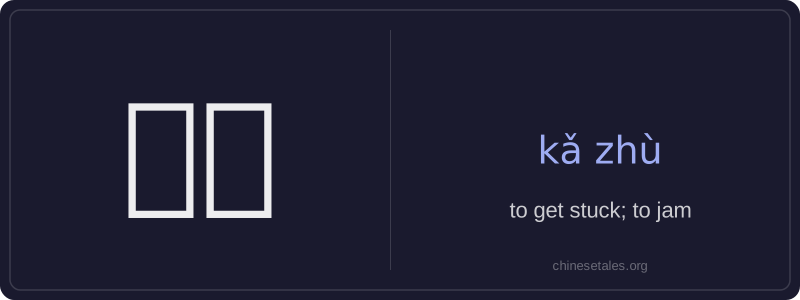
卡住 (kǎ zhù) is a compound verb meaning 'to get stuck' or 'to jam' — describing a situation where movement, flow, or function is suddenly obstructed and cannot proceed normally. The first character 卡 (kǎ) conveys the sense of being wedged, pinched, or caught between surfaces or forces; the second character 住 (zhù) functions as a resultative complement indicating completion or a state of being fixed in place. Together, they emphasize that something has become immovably lodged or blocked.
This verb is commonly used for physical objects (e.g., doors, gears, paper in printers), digital systems (e.g., apps freezing), or even abstract situations like speech ('his words got stuck') or decision-making ('the project stalled'). It implies temporary obstruction rather than permanent damage, and often suggests that external intervention may be needed to resolve it. While it can describe human actions (e.g., getting stuck in traffic), it’s rarely used for living beings physically trapped unless emphasizing mechanical or systemic constraint.
Example Sentences
Related Words
背后
背后 literally means 'back + behind' and functions
见面
见面 literally means 'see face' — combining 见 (t
面条
‘面条’ (miàn tiáo) literally means ‘flour str
我的
我的 (wǒ de) is a possessive pronoun meaning 'my'
中学
'Zhōngxué' literally combines 'zhōng' (middle)
后来
Later (hòulái) is an adverb meaning 'afterwards'
在家
'Zài jiā' literally combines the preposition 'z
不对
不对 (bù duì) literally combines 不 (bù), meani