Word Explanation
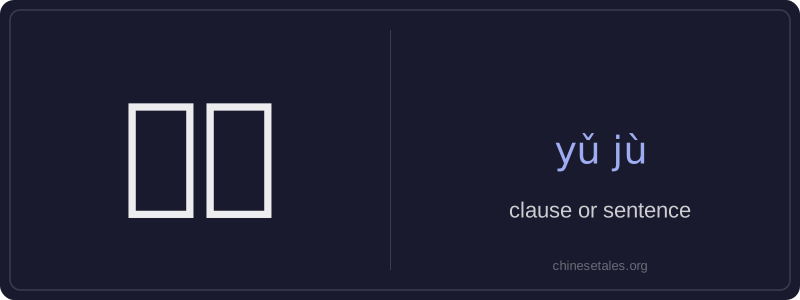
‘语句’ (yǔ jù) literally combines ‘语’ (yǔ), meaning ‘language’ or ‘speech’, and ‘句’ (jù), meaning ‘sentence’ or ‘clause’. Together, it refers to a grammatically complete unit of expression — typically a sentence or clause — especially in linguistic, educational, or computational contexts. Unlike the more colloquial ‘句子’ (jù zi), ‘语句’ carries a slightly formal or technical tone and is commonly used when discussing language structure, writing style, programming syntax, or logic.
It appears frequently in textbooks, grammar explanations, coding documentation (e.g., ‘SQL语句’), and language teaching materials. While both ‘语句’ and ‘句子’ can mean ‘sentence’, ‘语句’ emphasizes function and form — how a unit operates within a larger system — whereas ‘句子’ focuses on standalone communicative meaning. Learners should note that ‘语句’ is rarely used in casual speech; native speakers prefer ‘句子’ for everyday reference to sentences.
Example Sentences
Related Words
背后
背后 literally means 'back + behind' and functions
见面
见面 literally means 'see face' — combining 见 (t
面条
‘面条’ (miàn tiáo) literally means ‘flour str
我的
我的 (wǒ de) is a possessive pronoun meaning 'my'
中学
'Zhōngxué' literally combines 'zhōng' (middle)
后来
Later (hòulái) is an adverb meaning 'afterwards'
在家
'Zài jiā' literally combines the preposition 'z
不对
不对 (bù duì) literally combines 不 (bù), meani