Word Explanation
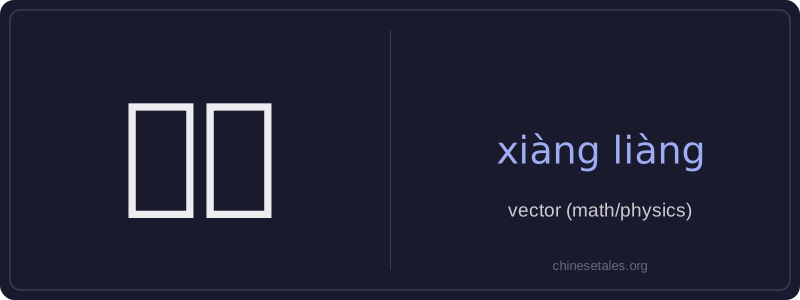
‘向量’ (xiàng liàng) is a technical noun borrowed from mathematics and physics, meaning ‘vector’—a quantity that has both magnitude and direction, such as velocity or force. The first character, 向 (xiàng), means ‘toward’ or ‘direction’, emphasizing the directional nature of the concept; the second, 量 (liàng), means ‘quantity’ or ‘measurement’, highlighting its measurable, numerical aspect. Together, they literally convey ‘a directed quantity’—an elegant and precise semantic fusion.
This term appears almost exclusively in academic, scientific, engineering, and technical contexts—especially in high school and university-level math, physics, and computer graphics courses. It is not used in everyday conversation or informal writing. Learners will encounter it in textbooks, lectures, and problem sets involving coordinate geometry, mechanics, or linear algebra—but never in daily topics like food, travel, or emotions.
Example Sentences
Related Words
背后
背后 literally means 'back + behind' and functions
见面
见面 literally means 'see face' — combining 见 (t
面条
‘面条’ (miàn tiáo) literally means ‘flour str
我的
我的 (wǒ de) is a possessive pronoun meaning 'my'
中学
'Zhōngxué' literally combines 'zhōng' (middle)
后来
Later (hòulái) is an adverb meaning 'afterwards'
在家
'Zài jiā' literally combines the preposition 'z
不对
不对 (bù duì) literally combines 不 (bù), meani