Word Explanation
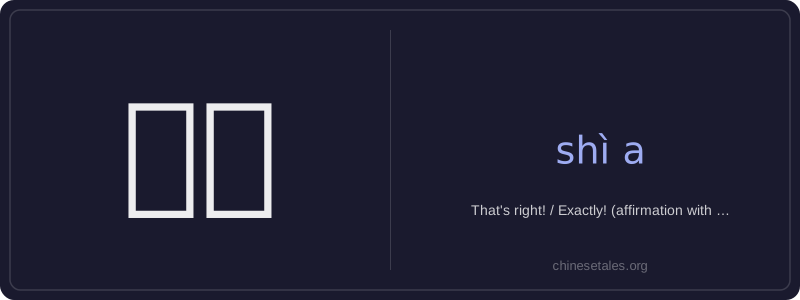
'Shì a' is a conversational interjection used to express warm, empathetic agreement — like saying 'That's right!' or 'Exactly!' with a tone of shared understanding or gentle confirmation. It combines the verb 是 (shì, 'to be') and the modal particle 啊 (a), which softens the statement and adds emotional resonance. Unlike plain 是, which is neutral or formal, 是啊 carries warmth, rapport, and often a hint of reflection or recognition — as if you’re nodding along with someone’s sentiment or experience.
This phrase is common in spoken Mandarin during friendly exchanges, especially when responding to observations, feelings, or relatable statements. It’s rarely used in writing or formal speech, and it’s almost always placed at the beginning or middle of a sentence — never at the end. Speakers often slightly raise the pitch on 啊 to convey sincerity or light surprise. It’s not used for factual corrections or strong assertions; for those, 是的 (shì de) or 没错 (méi cuò) are more appropriate.
Example Sentences
Related Words
背后
背后 literally means 'back + behind' and functions
见面
见面 literally means 'see face' — combining 见 (t
面条
‘面条’ (miàn tiáo) literally means ‘flour str
我的
我的 (wǒ de) is a possessive pronoun meaning 'my'
中学
'Zhōngxué' literally combines 'zhōng' (middle)
后来
Later (hòulái) is an adverb meaning 'afterwards'
在家
'Zài jiā' literally combines the preposition 'z
不对
不对 (bù duì) literally combines 不 (bù), meani