Word Explanation
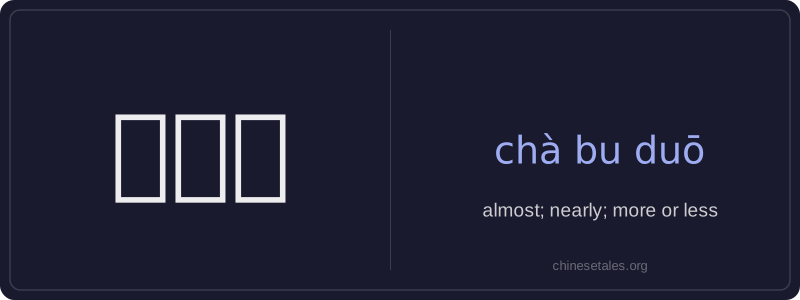
差不多 (chà bu duō) is an adverb meaning 'almost', 'nearly', or 'more or less'. Literally, 差 means 'to differ' or 'short of', 不 is the negation particle, and 多 means 'much' or 'many'; together they express the idea of 'not much difference' — i.e., something is very close to a state, quantity, time, or condition but not quite there. It's commonly used in casual speech to soften statements, express approximation, or indicate similarity without claiming exactness.
This expression appears frequently in daily conversations — for example, when estimating time ('It’s almost 3 p.m.'), describing resemblance ('They look nearly identical'), or downplaying differences ('The prices are more or less the same'). It can modify verbs, adjectives, or whole clauses, and often appears before the verb or at the sentence end. Unlike precise quantifiers, 差不多 conveys flexibility and tolerance for small variation, making it especially useful in informal, pragmatic communication.
Example Sentences
Related Words
背后
背后 literally means 'back + behind' and functions
中学
'Zhōngxué' literally combines 'zhōng' (middle)
见面
见面 literally means 'see face' — combining 见 (t
面条
‘面条’ (miàn tiáo) literally means ‘flour str
我的
我的 (wǒ de) is a possessive pronoun meaning 'my'
不对
不对 (bù duì) literally combines 不 (bù), meani
后来
Later (hòulái) is an adverb meaning 'afterwards'
在家
'Zài jiā' literally combines the preposition 'z