Word Explanation
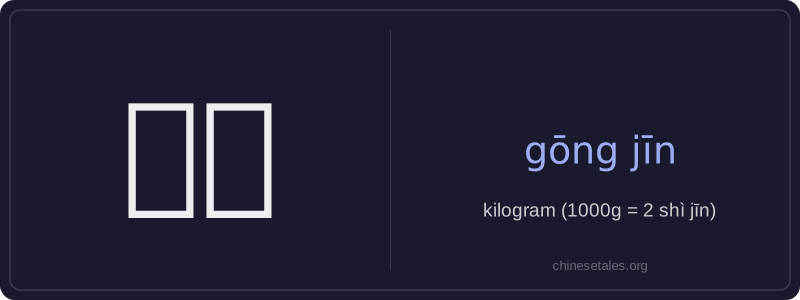
‘公斤’ is the standard Mandarin term for ‘kilogram’, the base unit of mass in the metric system. It literally combines 公 (gōng), meaning ‘public’ or ‘standard’, and 斤 (jīn), a traditional Chinese unit of weight roughly equal to 500 grams. Together, 公斤 signifies the ‘standard jīn’ — that is, the officially adopted metric version, equivalent to 1,000 grams (or 2 traditional shì jīn). This term is universally used in mainland China, scientific contexts, commerce, nutrition labels, and official measurements.
Unlike the traditional 斤 (which varies regionally but is standardized as 500 g in modern China), 公斤 avoids ambiguity and aligns with international standards. You’ll encounter it frequently in supermarkets, recipes, medical dosages, luggage weight limits, and fitness tracking. It’s neutral in register — appropriate for both formal reports and casual conversation — and always functions as a countable noun, typically preceded by a number or measure word like ‘一’ or ‘几’.
Example Sentences
Related Words
背后
背后 literally means 'back + behind' and functions
中学
'Zhōngxué' literally combines 'zhōng' (middle)
见面
见面 literally means 'see face' — combining 见 (t
面条
‘面条’ (miàn tiáo) literally means ‘flour str
我的
我的 (wǒ de) is a possessive pronoun meaning 'my'
不对
不对 (bù duì) literally combines 不 (bù), meani
后来
Later (hòulái) is an adverb meaning 'afterwards'
在家
'Zài jiā' literally combines the preposition 'z