Word Explanation
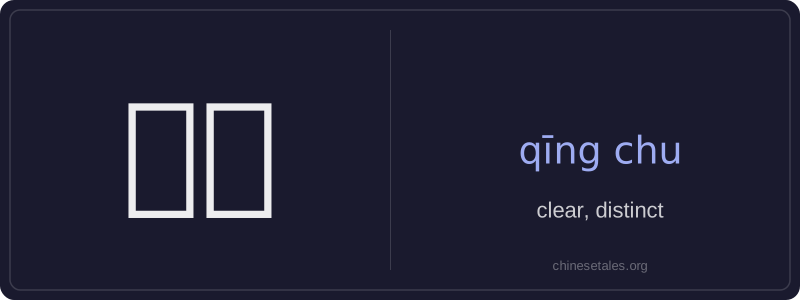
‘清楚’ (qīng chǔ) is an adjective meaning 'clear' or 'distinct' — describing something easily perceived, understood, or seen. Literally, 清 means 'clear, pure', and 楚 means 'distinct, well-defined'; together they emphasize sharpness of perception or comprehension. It’s commonly used to describe clarity in speech, vision, thought, writing, or instructions — for example, when someone speaks clearly, a document is legible, or an idea is well-explained.
The word functions as a predicate adjective (e.g., 这个问题很清楚 — 'This question is very clear') or as a complement after verbs like 看、听、说、明白 (e.g., 听清楚了 — 'heard clearly'). It can also appear in the reduplicated form 清清楚楚 for emphasis, meaning 'very clearly'. Unlike some adjectives, it doesn’t require 很 before it in affirmative statements when used predicatively, though 很 is often added for nuance.
Example Sentences
Related Words
背后
背后 literally means 'back + behind' and functions
不对
不对 (bù duì) literally combines 不 (bù), meani
中学
'Zhōngxué' literally combines 'zhōng' (middle)
见面
见面 literally means 'see face' — combining 见 (t
面条
‘面条’ (miàn tiáo) literally means ‘flour str
我的
我的 (wǒ de) is a possessive pronoun meaning 'my'
后来
Later (hòulái) is an adverb meaning 'afterwards'
在家
'Zài jiā' literally combines the preposition 'z