Word Explanation
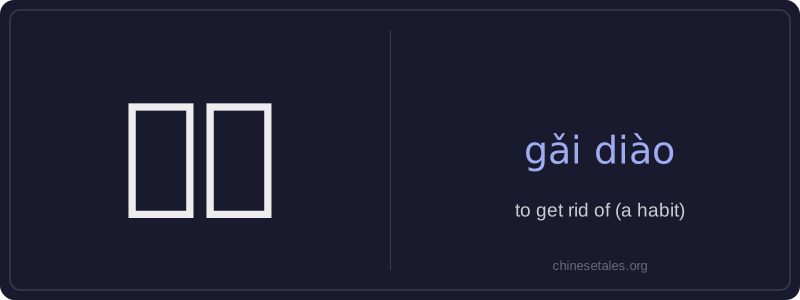
‘改掉’ is a verb meaning ‘to get rid of’ or ‘to break’—especially a habit, behavior, or undesirable pattern. It combines the character 改 (gǎi), meaning ‘to change’ or ‘to correct’, with 掉 (diào), which indicates removal, loss, or completion of an action. Together, they convey the sense of actively eliminating something persistent and habitual—not just changing it superficially, but removing it entirely.
This phrase is commonly used in contexts related to self-improvement, health, and daily routines: quitting smoking, reducing screen time, stopping nail-biting, or overcoming procrastination. It implies effort, intention, and often a process over time—not an instantaneous fix. While grammatically it functions as a separable verb (e.g., 改不掉, 改掉了, 要改掉), it’s almost always followed by a noun object (e.g., 坏习惯, 晚睡的习惯) and rarely stands alone.
Example Sentences
Related Words
国语
‘Guó yǔ’ literally means 'national language'—
面条
‘面条’ (miàn tiáo) literally means ‘flour str
背后
背后 literally means 'back + behind' and functions
认同
‘认同’ (tóng rèn) is a verb meaning ‘to ident
无论谁
‘无论谁’ (wú lùn shéi) is a pronoun meaning
中学
'Zhōngxué' literally combines 'zhōng' (middle)
见面
见面 literally means 'see face' — combining 见 (t
外语
‘外语’ literally means ‘outside language’ —