Word Explanation
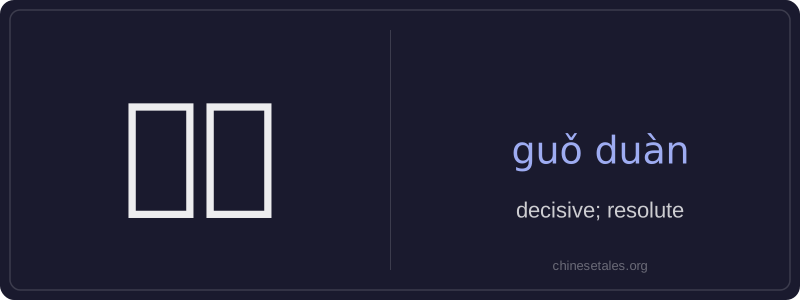
果断 (guǒ duàn) is an adjective meaning 'decisive' or 'resolute'—describing someone who makes clear, firm decisions quickly and confidently, without hesitation or doubt. The first character 果 (guǒ) originally means 'fruit', but here it carries the sense of 'result' or 'consequence', implying an outcome that follows directly from action. The second character 断 (duàn) means 'to cut off' or 'to decide', suggesting the act of cutting away uncertainty or indecision. Together, they evoke the image of decisively severing doubt to arrive at a firm conclusion.
This word is commonly used to praise leadership qualities, personal character, or effective problem-solving—especially in contexts involving responsibility, crisis response, or professional judgment. It carries a positive, commendatory tone and often appears in formal writing, performance reviews, or motivational speech. While it describes a trait, it’s rarely used as a noun on its own; instead, it modifies nouns (e.g., 果断的决定, 'a decisive decision') or functions predicatively (e.g., 他很果断, 'He is decisive').
Example Sentences
Related Words
国语
‘Guó yǔ’ literally means 'national language'—
面条
‘面条’ (miàn tiáo) literally means ‘flour str
背后
背后 literally means 'back + behind' and functions
认同
‘认同’ (tóng rèn) is a verb meaning ‘to ident
无论谁
‘无论谁’ (wú lùn shéi) is a pronoun meaning
中学
'Zhōngxué' literally combines 'zhōng' (middle)
见面
见面 literally means 'see face' — combining 见 (t
外语
‘外语’ literally means ‘outside language’ —