Word Explanation
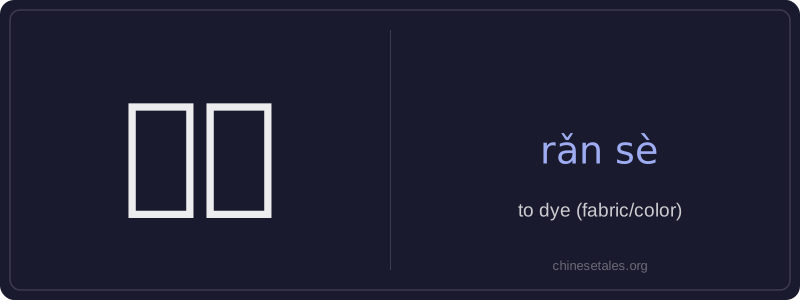
‘染色’ (rǎn sè) literally means ‘to apply color’ — 染 (rǎn) means ‘to dye’ or ‘to stain’, and 色 (sè) means ‘color’. Together, they form a verb meaning ‘to dye’ (especially fabrics, hair, or biological specimens), emphasizing the intentional application of pigment to change appearance. It’s commonly used in contexts like textile production, hair styling, scientific lab work (e.g., staining cells for microscopy), and traditional crafts.
Unlike the more general term 上色 (shàng sè, ‘to add color’, often for art or digital graphics), 染色 implies a deeper, often chemical or permanent color infusion — think soaking cloth in dye or treating tissue samples. It can be transitive (taking a direct object: 染色布料) or used in passive constructions (被染色). The word carries a neutral-to-formal register and is rarely used metaphorically.
Example Sentences
Related Words
国语
‘Guó yǔ’ literally means 'national language'—
面条
‘面条’ (miàn tiáo) literally means ‘flour str
背后
背后 literally means 'back + behind' and functions
认同
‘认同’ (tóng rèn) is a verb meaning ‘to ident
无论谁
‘无论谁’ (wú lùn shéi) is a pronoun meaning
中学
'Zhōngxué' literally combines 'zhōng' (middle)
见面
见面 literally means 'see face' — combining 见 (t
外语
‘外语’ literally means ‘outside language’ —