Word Explanation
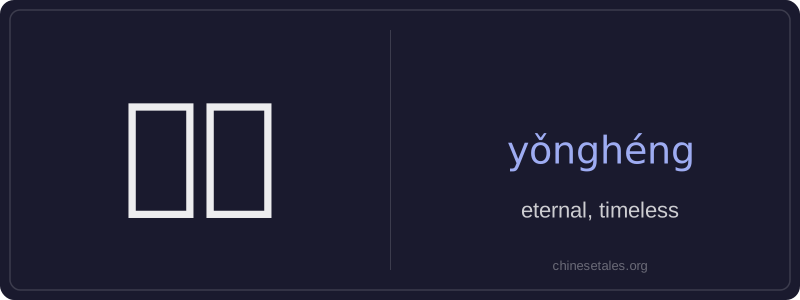
‘永恒’ (yǒnghéng) is an adjective meaning ‘eternal’ or ‘timeless’—describing something that lasts forever, without beginning or end. The first character 永 (yǒng) means ‘forever’ or ‘perpetually’, often evoking boundlessness in time; the second character 恒 (héng) means ‘constant’, ‘enduring’, or ‘unchanging’. Together, they form a compound emphasizing absolute, unbroken continuity—stronger and more poetic than either character alone. It’s commonly used in literary, philosophical, or emotional contexts: love, truth, memory, nature, or ideals.
While it can technically modify nouns directly (e.g., 永恒的爱), it frequently appears in abstract or elevated expressions—poetry, speeches, slogans, or heartfelt declarations—not in casual daily speech. It carries a solemn, almost sacred weight, so using it for mundane things (e.g., ‘eternal coffee’) would sound exaggerated or ironic. Learners should note that it rarely functions as a noun on its own; when nominalized, it usually appears with 的 or in phrases like 永恒之美 (the beauty of eternity).
Example Sentences
Related Words
国语
‘Guó yǔ’ literally means 'national language'—
面条
‘面条’ (miàn tiáo) literally means ‘flour str
背后
背后 literally means 'back + behind' and functions
认同
‘认同’ (tóng rèn) is a verb meaning ‘to ident
无论谁
‘无论谁’ (wú lùn shéi) is a pronoun meaning
中学
'Zhōngxué' literally combines 'zhōng' (middle)
见面
见面 literally means 'see face' — combining 见 (t
外语
‘外语’ literally means ‘outside language’ —