Word Explanation
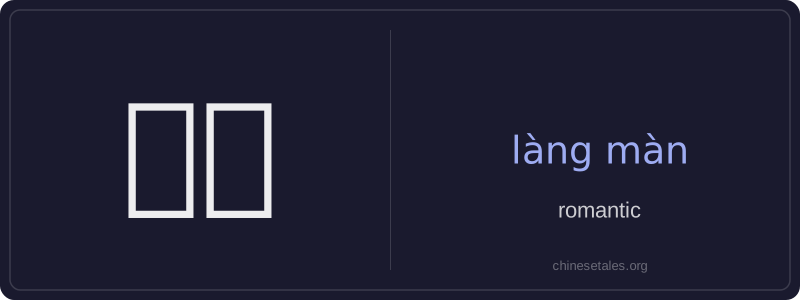
浪漫 (làng màn) is an adjective meaning 'romantic' — describing feelings, actions, or atmospheres associated with love, idealism, passion, and poetic sensitivity. Though written with two characters, 浪 (làng) originally evokes imagery of waves — suggesting fluidity, spontaneity, and unrestrained emotion — while 漫 (màn) means 'spreading', 'overflowing', or 'unbounded', reinforcing the sense of abundant, unrestrained feeling. Together, they convey a rich, emotionally vivid quality that goes beyond simple affection: think candlelit dinners, handwritten letters, stargazing walks, or grand gestures born of deep feeling.
The word is commonly used to describe people (e.g., a romantic partner), behaviors (a romantic proposal), settings (a romantic café), or even artistic styles (romantic poetry). It carries positive connotations in modern Chinese, though overuse or inappropriate application (e.g., calling a business meeting 'romantic') may sound ironic or humorous. Unlike English 'romantic', it rarely functions as a noun in Chinese without modification (e.g., 浪漫主义 for 'romanticism').
Example Sentences
Related Words
国语
‘Guó yǔ’ literally means 'national language'—
面条
‘面条’ (miàn tiáo) literally means ‘flour str
无论谁
‘无论谁’ (wú lùn shéi) is a pronoun meaning
背后
背后 literally means 'back + behind' and functions
外语
‘外语’ literally means ‘outside language’ —
认同
‘认同’ (tóng rèn) is a verb meaning ‘to ident
中学
'Zhōngxué' literally combines 'zhōng' (middle)
见面
见面 literally means 'see face' — combining 见 (t