Word Explanation
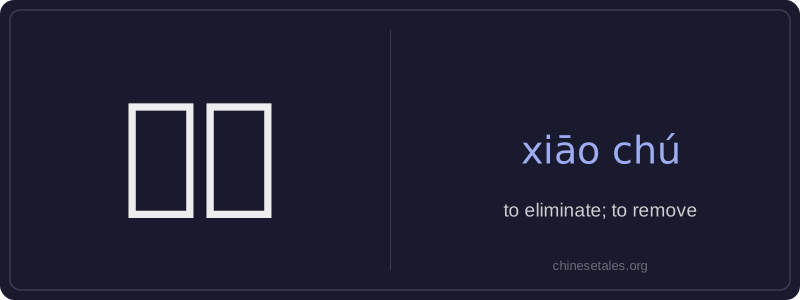
消除 (xiāo chú) is a transitive verb meaning 'to eliminate' or 'to remove'—especially something unwanted, harmful, or unnecessary. The character 消 (xiāo) conveys the idea of disappearance or dissipation, while 除 (chú) means 'to remove' or 'to get rid of'; together, they emphasize complete and deliberate eradication. It’s commonly used in formal, technical, or written contexts—not casual speech—and often appears with abstract nouns like risks, doubts, obstacles, pollution, or diseases.
This word implies an active, intentional effort to make something cease to exist or have effect. Unlike simpler verbs like 去掉 (qù diào) or 清除 (qīng chú), 消除 carries a stronger sense of thoroughness and finality, frequently appearing in official announcements, health guidelines, environmental reports, or safety instructions. It’s rarely used for physical objects you’d simply throw away—more for systemic, conceptual, or persistent problems that require intervention.
Example Sentences
Related Words
国语
‘Guó yǔ’ literally means 'national language'—
面条
‘面条’ (miàn tiáo) literally means ‘flour str
无论谁
‘无论谁’ (wú lùn shéi) is a pronoun meaning
背后
背后 literally means 'back + behind' and functions
外语
‘外语’ literally means ‘outside language’ —
认同
‘认同’ (tóng rèn) is a verb meaning ‘to ident
中学
'Zhōngxué' literally combines 'zhōng' (middle)
见面
见面 literally means 'see face' — combining 见 (t