Word Explanation
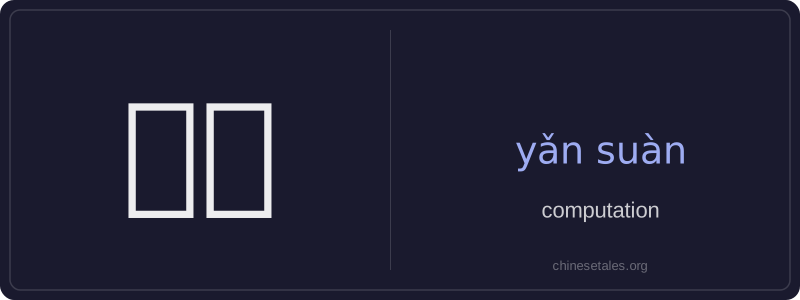
演算 means 'computation'—the process of performing mathematical or logical operations to solve a problem or derive a result. The character 演 (yǎn) originally means 'to perform, to unfold, or to carry out', while 算 (suàn) means 'to calculate, to compute, or to reckon'. Together, they emphasize the active, step-by-step execution of calculations—not just the final answer, but the methodical working through of steps, often in formal, technical, or academic contexts.
This term is commonly used in mathematics, computer science, engineering, and physics. It appears in phrases like '演算过程' (computation process), '演算能力' (computational ability), or '数值演算' (numerical computation). Unlike everyday words like 计算 (jì suàn), which can refer to simple arithmetic or even casual estimation, 演算 carries a more rigorous, systematic connotation—often implying symbolic manipulation, algorithmic procedures, or theoretical derivation.
Example Sentences
Related Words
国语
‘Guó yǔ’ literally means 'national language'—
面条
‘面条’ (miàn tiáo) literally means ‘flour str
无论谁
‘无论谁’ (wú lùn shéi) is a pronoun meaning
背后
背后 literally means 'back + behind' and functions
外语
‘外语’ literally means ‘outside language’ —
认同
‘认同’ (tóng rèn) is a verb meaning ‘to ident
中学
'Zhōngxué' literally combines 'zhōng' (middle)
见面
见面 literally means 'see face' — combining 见 (t