Word Explanation
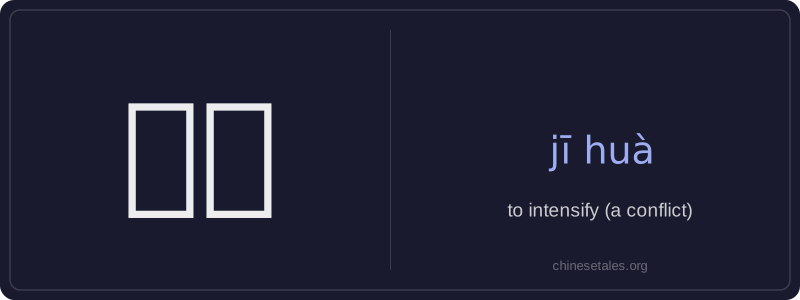
激化 (jī huà) is a verb meaning 'to intensify'—especially a negative situation such as a conflict, disagreement, tension, or crisis. The first character 激 (jī) means 'to stimulate' or 'to provoke', often with force or urgency; the second character 化 (huà) means 'to change into' or 'to become'. Together, they convey the idea of a situation escalating from mild to severe, often rapidly and uncontrollably. It’s commonly used in political, social, interpersonal, or emotional contexts where underlying friction worsens.
This word carries a distinctly negative connotation—it implies deterioration rather than neutral change. It’s frequently found in news reports, academic analysis, and formal speech, but rarely in casual conversation. 激化 is almost always transitive: it requires an object (e.g., 激化矛盾, 激化局势). Unlike general verbs like 加剧 (jiājù), 激化 emphasizes a qualitative shift—often marking the point where resolution becomes significantly harder.
Example Sentences
Related Words
国语
‘Guó yǔ’ literally means 'national language'—
面条
‘面条’ (miàn tiáo) literally means ‘flour str
无论谁
‘无论谁’ (wú lùn shéi) is a pronoun meaning
背后
背后 literally means 'back + behind' and functions
外语
‘外语’ literally means ‘outside language’ —
认同
‘认同’ (tóng rèn) is a verb meaning ‘to ident
中学
'Zhōngxué' literally combines 'zhōng' (middle)
见面
见面 literally means 'see face' — combining 见 (t