Word Explanation
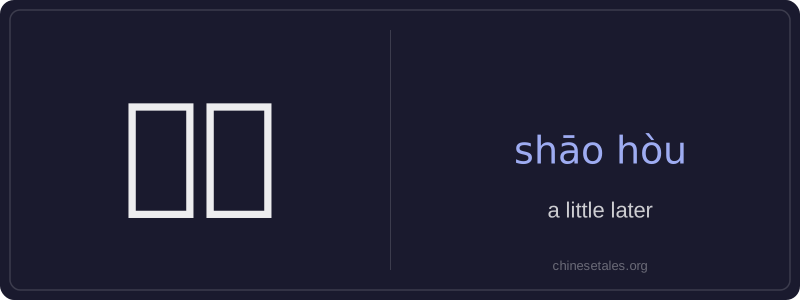
稍后 (shāo hòu) is an adverb meaning 'a little later' or 'shortly after.' It combines 稍 (shāo), meaning 'slightly' or 'a little,' and 后 (hòu), meaning 'after' or 'later.' Together, they express a short, indefinite delay — not immediate, but not far off either. It’s commonly used in both spoken and written Chinese to indicate that something will happen soon, often in polite or neutral contexts like scheduling, service interactions, or casual plans.
This word is more formal and concise than phrases like 过一会儿 (guò yī huìr) or 一会儿以后 (yī huìr yǐhòu), though all convey similar timing. It frequently appears at the beginning or end of a sentence, and it never takes aspect markers like 了 or 过. Unlike verbs or nouns, 稍后 functions solely as a time adverbial — it cannot serve as a subject or object, nor can it be modified by degree adverbs like 很 or 非常.
Example Sentences
Related Words
国语
‘Guó yǔ’ literally means 'national language'—
面条
‘面条’ (miàn tiáo) literally means ‘flour str
认同
‘认同’ (tóng rèn) is a verb meaning ‘to ident
无论谁
‘无论谁’ (wú lùn shéi) is a pronoun meaning
背后
背后 literally means 'back + behind' and functions
外语
‘外语’ literally means ‘outside language’ —
中学
'Zhōngxué' literally combines 'zhōng' (middle)
见面
见面 literally means 'see face' — combining 见 (t