Word Explanation
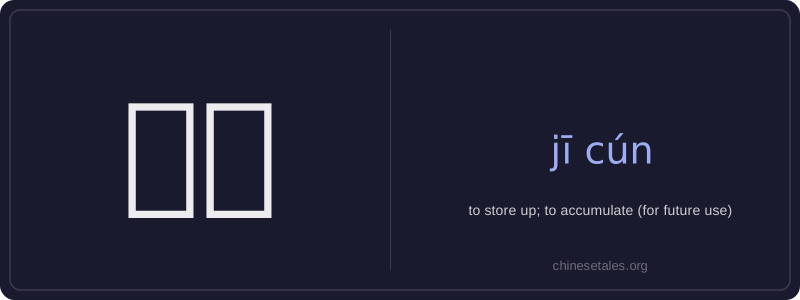
积存 is a verb meaning 'to store up' or 'to accumulate (for future use)'. It combines two characters: 积 (jī), meaning 'to accumulate' or 'to pile up', and 存 (cún), meaning 'to store', 'to keep', or 'to preserve'. Together, they emphasize the intentional, gradual gathering of something—often tangible resources like money, food, or supplies—with the purpose of saving it for later. Unlike simple verbs like 保存 (bǎo cún, 'to preserve') or 储存 (chǔ cún, 'to store'), 积存 carries a nuance of steady, often long-term accumulation, sometimes implying thrift, preparation, or even unintended buildup (e.g., dust or debt).
This word commonly appears in contexts involving personal finance, household management, disaster preparedness, or resource planning. It’s frequently used with nouns such as 钱 (qián, 'money'), 粮食 (liángshí, 'grain/food'), or 经验 (jīngyàn, 'experience'). While grammatically transitive, it rarely takes aspect particles like 了 or 过 unless specifying completion—instead, it often appears with time phrases (e.g., 多年来, 'over the years') or modifiers like 逐渐 (zhújiàn, 'gradually').
Example Sentences
Related Words
国语
‘Guó yǔ’ literally means 'national language'—
面条
‘面条’ (miàn tiáo) literally means ‘flour str
认同
‘认同’ (tóng rèn) is a verb meaning ‘to ident
无论谁
‘无论谁’ (wú lùn shéi) is a pronoun meaning
背后
背后 literally means 'back + behind' and functions
外语
‘外语’ literally means ‘outside language’ —
认为
‘认为’ (rèn wéi) is a transitive verb meaning
中学
'Zhōngxué' literally combines 'zhōng' (middle)