Word Explanation
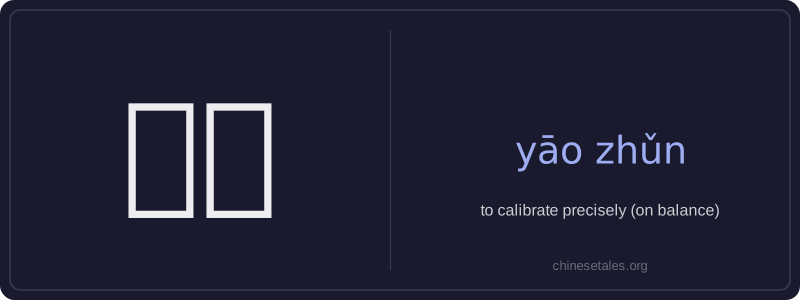
‘约准’ (yāo zhǔn) is a verb meaning ‘to calibrate precisely’, especially when adjusting the sensitivity or reading of a measuring instrument—most commonly a balance or scale—so that it displays accurate, reliable measurements. The character 约 (yāo) here carries the sense of ‘to regulate’ or ‘to adjust to a standard’, while 准 (zhǔn) means ‘accurate’, ‘precise’, or ‘in alignment’. Together, they form a compound emphasizing intentional, fine-tuned adjustment toward exactness.
This term is used primarily in technical, medical, or laboratory contexts—such as hospital labs, pharmacy preparation, or quality control—where measurement fidelity is critical. It implies more than simple zeroing; it involves verifying and correcting against known standards. While occasionally used metaphorically, its core usage remains concrete and procedural. Learners should note that 约准 is not interchangeable with general verbs like 调整 (tiáozhěng, ‘to adjust’) or 校准 (jiàozhǔn, ‘to calibrate’) — it specifically conveys precision calibration, often on balances used for weighing medicines or biological samples.
Example Sentences
Related Words
国语
‘Guó yǔ’ literally means 'national language'—
面条
‘面条’ (miàn tiáo) literally means ‘flour str
无论谁
‘无论谁’ (wú lùn shéi) is a pronoun meaning
背后
背后 literally means 'back + behind' and functions
外语
‘外语’ literally means ‘outside language’ —
认同
‘认同’ (tóng rèn) is a verb meaning ‘to ident
中学
'Zhōngxué' literally combines 'zhōng' (middle)
认为
‘认为’ (rèn wéi) is a transitive verb meaning