胜
Character Story & Explanation
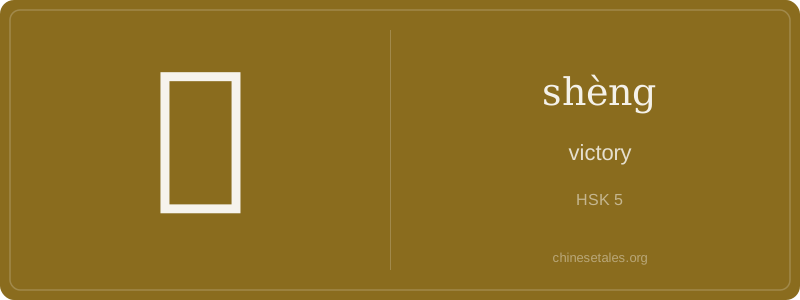
The earliest form of 胜 appears on Warring States bamboo slips — not as a pictograph of battle, but as a phonetic-semantic compound: left side ⺼ (flesh/body, hinting at human effort), right side 朕 (zhèn, archaic ‘I’ — later imperial pronoun), which served as both sound clue and conceptual anchor: ‘I triumph’. Over centuries, 朕 simplified into 月 + 生, then further stylized to the modern 胜 shape. Look closely: the top-left stroke hooks like a raised fist; the lower right 丿 and ㇏ flare outward like arms throwing up in celebration — the whole character literally *reaches upward* in triumph.
This visual energy matched its evolving meaning. In the Zuo Zhuan, 胜 describes moral superiority: ‘He who wins by virtue, not force, truly 胜.’ By the Tang dynasty, it expanded into aesthetics — Du Fu wrote of mountains ‘outshining’ (胜) all others in grandeur. Even today, when we say 景色很胜 (jǐngsè hěn shèng), we’re echoing ancient literati who measured beauty by its power to *overwhelm* the senses — not merely please them.
At its heart, 胜 (shèng) is about *triumph that feels earned* — not just winning a game, but prevailing over difficulty, outshining others, or mastering something complex. It carries weight and dignity: you don’t ‘win’ a snack with 胜; you win a debate, a war, an exam, or even a philosophical argument. Its radical ⺼ (‘meat/flesh’) hints at the body’s role in struggle — victory isn’t abstract; it’s visceral, embodied, sometimes exhausting.
Grammatically, 胜 is most often a verb (‘to win/be victorious’) or part of compound nouns/adjectives. As a verb, it usually appears in formal or literary contexts — you’ll hear 获胜 (huò shèng, ‘to achieve victory’) more than plain 胜 alone. Crucially, it *doesn’t* take aspect particles like 了 or 过 directly: you say 他获胜了, not 他胜了 (though classical texts do use 胜 as a standalone verb). Learners often mistakenly use it like English ‘win’ in casual speech — but native speakers prefer 打赢 (dǎ yíng) for everyday contests or 赢得 (yíng de) for achievements.
Culturally, 胜 evokes Confucian and military ideals — think Sun Tzu’s Art of War, where ‘knowing yourself and your enemy ensures victory’ (知彼知己,百战不殆;不知彼而知己,一胜一负). The character also appears in place names like 西湖十胜 (Xīhú Shí Shèng, ‘Ten Views of West Lake’), where 胜 means ‘scenic excellence’ — revealing how deeply victory and aesthetic mastery are linked in Chinese thought. A common slip? Confusing it with 生 (shēng, ‘life’) — misreading 胜 as 生 makes your ‘victory speech’ sound like a biology lecture!