滑
Character Story & Explanation
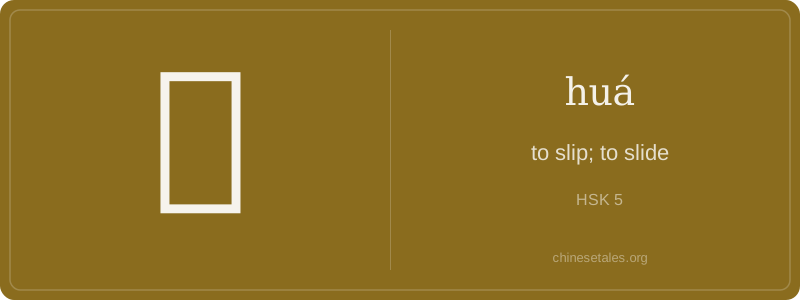
The earliest form of 滑 appears in Warring States bamboo texts as a compound: left side 氵 (water radical), right side 骨 (bone) — but not the modern 骨! It was originally 骨 with extra curved strokes suggesting *smooth, rounded contours*, evoking water flowing over polished stone or bone. Over centuries, the right-hand component simplified from 骨 to 华 (huá), phonetically matching the sound — though visually, it now looks like 十 + 匕 + 七, which ironically mimics the wobble of slipping: ten steps, then a fall (匕), then seven attempts to recover!
This visual evolution mirrors its semantic journey: from concrete ‘water gliding over smooth stone’ (in《说文解字》: ‘利也,一曰滑,利也’ — ‘smoothness, one meaning is smoothness’) to broader ideas of fluid motion and even moral agility. By the Tang dynasty, poets like Li Bai used 滑 in lines like ‘滑泥行潦’ (sliding through mud and puddles) — praising adaptability over rigidity. The character’s very shape — three water dots rushing left, then a ‘flowing’ right half — encodes motion physics millennia before Newton.
Imagine you’re on a rainy Beijing sidewalk, sprinting to catch the subway — and suddenly your foot shoots out sideways like it’s on an ice rink. That instant loss of traction? That’s 滑 (huá). It’s not just ‘slip’ as in accident; it’s the *feeling* of uncontrolled momentum — smooth, fast, and slightly dangerous. In Chinese, 滑 carries a tactile vividness: it describes surfaces (冰面很滑), actions (他滑倒了), and even abstract qualities (说话太滑 — 'his speech is too slick').
Grammatically, 滑 is versatile: it works as a verb (滑下山坡), an adjective (滑溜溜的面条), and even appears in reduplicated forms (滑滑的) for emphasis. Learners often mistakenly use it where English says 'slippery' — but in Chinese, you’d say 这地板滑 (this floor is slippery), not *这地板在滑 — because 滑 here is stative, not progressive. Also, never confuse it with 滑稽 (huájī): that ‘slippery’ root evolved into ‘comical’ — because early clowns used exaggerated, unsteady movements to provoke laughter!
Culturally, 滑 hints at a Daoist-tinged appreciation for effortless flow: 滑行 (gliding), 滑翔 (soaring), even 滑头 (sly person — literally ‘slippery head’) reflects how physical slipperiness metaphors extend into social intelligence. A common error? Using 滑 instead of 溜 (liū) for ‘sneak away’ — but 溜 implies intentional stealth, while 滑 is inherently unintentional or surface-driven.