扁
Character Story & Explanation
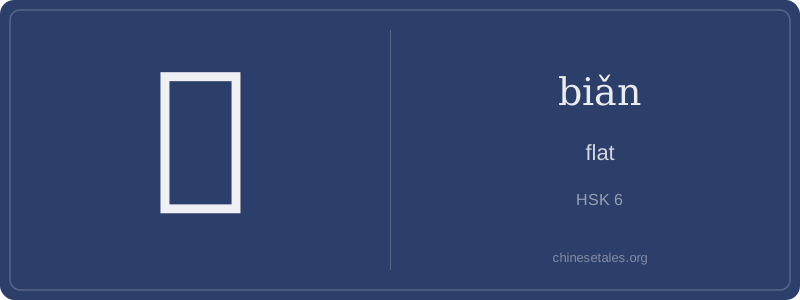
The earliest form of 扁 appears in bronze inscriptions as a pictograph combining two key elements: a door-like frame (户) and a compressed shape inside — originally depicted as a horizontal line squeezed between two vertical strokes, like something pressed between boards. Over time, the interior evolved into the component 册 (cè, ‘bamboo slips’), stylized as two parallel horizontal lines crossed by short verticals — symbolizing flattened, bound documents. By the seal script era, the door radical anchored the left side, while the right side condensed into the modern 册-like shape, preserving the sense of ‘something confined and flattened within boundaries’.
This visual logic shaped its semantic journey: from ‘flattened bamboo slips’ (early writing medium) to ‘flat objects’ generally, then metaphorically to ‘low status’ (as in 扁担, a humble carrying pole) and even ‘deflated spirit’ (e.g., 扁了, ‘feeling crushed’). In the *Shuōwén Jiězì* (100 CE), Xu Shen defined it as ‘pressing down to make level’, confirming its active, compressive core. Its enduring link to humility and restraint — seen in terms like 扁额 (biǎn’é, ‘horizontal tablet’ above temple doors) — reflects how Chinese aesthetics value flatness not as barrenness, but as disciplined containment.
Imagine you’re at a Beijing street stall watching a master baozi chef slam dough onto the counter — *thwack!* — then press it flat with his palm before stuffing it. That deliberate, forceful flattening? That’s 扁 (biǎn) in action: not just ‘flat’ as a static state like a sheet of paper, but flatness achieved through pressure, compression, or intentional shaping. It evokes tactile, almost physical flatness — think flattened pancakes, squashed insects, or a person suddenly looking deflated after bad news.
Grammatically, 扁 is mostly an adjective (e.g., 扁平 biǎnpíng ‘flat and thin’) or used in compound verbs like 扁下去 (biǎn xiàqù, ‘to flatten down’), often implying reduction in thickness or status. Crucially, it’s rarely used alone in modern speech — you won’t say *‘This table is 扁’*; instead, you’d say *‘This table is 扁平的’* or use it in compounds. Learners often overuse it like English ‘flat’, missing that native speakers prefer 低 (dī, ‘low’), 薄 (bó, ‘thin’), or 平 (píng, ‘level’) depending on context — 扁 carries subtle connotations of being *compressed*, *squashed*, or even *undignified* (e.g., 扁担儿 biǎndànr ‘carrying pole’ — curved, yet named for its flattened cross-section).
Culturally, 扁 has a quiet irony: though it means ‘flat’, its radical 户 (hù, ‘door’) hints at enclosure and domestic space — suggesting flatness not as emptiness, but as containment. And yes, it *can* be pronounced piān — but only in rare, archaic contexts like the classical term 扁舟 (piānzhōu, ‘a small, narrow boat’), where piān means ‘slight’ or ‘small’. Don’t worry — for HSK 6, biǎn is your only friend.