扎
Character Story & Explanation
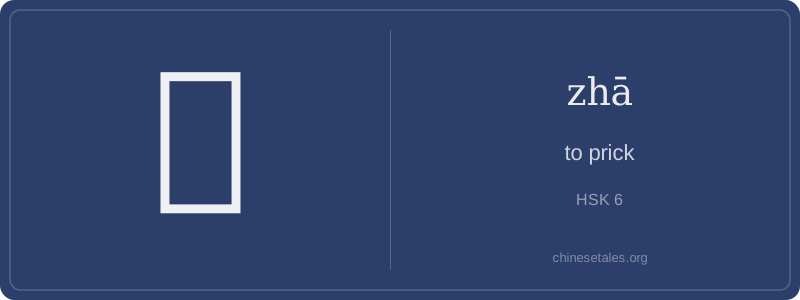
The earliest form of 扎 appears in late Warring States bamboo slips — not as a pictograph, but as a phono-semantic compound: left side 扌 (hand radical), right side 札 (zhá), a character originally depicting a wooden tally stick with notches cut into it. Those notches? They were literally *cut-in*, *incised* — the visual seed of ‘pricking’. Over centuries, 札 simplified: its ‘wood’ (木) component shrank and merged, while the ‘knife-like’ stroke on top sharpened into today’s single diagonal dot — now unmistakably a needle’s tip descending.
This evolution mirrors meaning expansion: from carving marks on wood (札) → making sharp incisions (扎) → any sudden penetration (skin, fabric, reputation). In the Book of Rites, 扎 appears in ritual contexts describing ‘piercing cloth for binding’, foreshadowing its later use in both medicine and metaphor. Even today, the four strokes tell the story: three for the hand’s grip (扌 = three strokes: horizontal, vertical, lift), one for the sharp, decisive thrust — a minimalist masterpiece of kinetic energy.
Think of 扎 (zhā) as Chinese acupuncture’s linguistic twin — not the calm, meditative practice, but the sharp, sudden *ping!* when the needle breaks skin. It’s not just 'to prick' like a pin; it’s the visceral, momentary violation of surface: a thorn in your finger, a syringe entering flesh, or even a rumor ‘pricking’ someone’s reputation. Unlike English verbs that soften over time (e.g., 'stab' → 'poke'), 扎 stays insistently physical and immediate — always active, always directional, and almost always followed by an object (扎针, 扎破, 扎进).
Grammatically, 扎 is a versatile action verb that loves objects and directional complements. You don’t just ‘扎’ — you 扎*进* the muscle (‘prick into’), 扎*破* the balloon (‘prick until it bursts’), or 扎*了*一下 (‘pricked once’ — with the perfective 了). Learners often wrongly use it intransitively (‘I pricked’ without saying *what* or *where*), but native speakers treat 扎 like a surgeon’s scalpel: it demands precision — subject + 扎 + [object] + [direction/complement].
Culturally, 扎 carries subtle weight beyond pain: in idioms like 扎根 (‘take root’), it transforms from injury to deep, tenacious belonging — like bamboo rhizomes piercing soil. And watch out for the zā pronunciation (as in 扎辫子 ‘to tie braids’): same character, totally different etymology and tone — a classic HSK 6 trap where one glyph wears two linguistic masks.