奋
Character Story & Explanation
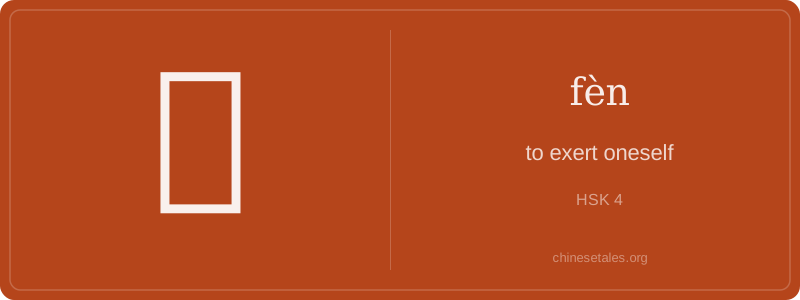
The earliest form of 奋 appears in bronze inscriptions as a vivid pictograph: a large bird (represented by the top part, later stylized into the radical 大 + the ‘feathers’ component) with wings spread wide, taking off forcefully from the ground — its legs pushing up, feathers bristling. That original image wasn’t abstract: it was a soaring pheasant or crane, symbolizing explosive upward motion and vigorous release. Over centuries, the bird’s body simplified into 大 (dà, ‘big’), while the ‘feathers’ evolved into the right-side component 币 (bì, originally meaning ‘curled feathers’ — unrelated to the modern word for ‘currency’). By the Han dynasty, the character stabilized into today’s 8-stroke form: 大 + 币, visually shouting ‘big lift-off!’
This avian origin explains everything: 奋 never meant mere physical labor — it meant *launching* — rising above inertia, transcending limits. In the Classic of Poetry (Shījīng), early uses describe warriors rousing themselves before battle, ‘like a crane taking wing’. Later, in Zhu Xi’s Neo-Confucian commentaries, 奋 became moral vocabulary: ‘fèn fā xīn zhì’ (to rouse one’s mind and will). The visual logic holds — you can’t soar without first pushing hard against the earth. So every time you write those eight strokes, you’re drawing the arc of ascent itself.
At its heart, 奋 (fèn) isn’t just ‘to exert oneself’ — it’s the quiet roar of focused will: the student pulling an all-nighter before finals, the athlete tightening their jaw mid-sprint, the entrepreneur revising a pitch for the tenth time. It carries urgency and dignity, never desperation. Unlike English ‘struggle’ or ‘try hard’, 奋 implies purposeful, upward-directed energy — often toward moral, academic, or collective goals. You’ll rarely hear it in casual speech alone; it almost always appears in compounds (like 奋斗 or 奋发) or with adverbs like 努力地 or 不懈地.
Grammatically, 奋 is almost never used as a standalone verb in modern Mandarin. You won’t say *‘I fèn’ — instead, it anchors compound verbs: 奋斗 (fèndòu, ‘to strive’), 奋发 (fènfā, ‘to rouse oneself’), or appears in set phrases like 奋不顾身 (fèn bù gù shēn, ‘to risk one’s life’). Its presence signals intensity and intentionality — so when learners mistakenly use it solo (e.g., *‘他奋了’), native speakers blink, wondering what kind of poetic drama just unfolded.
Culturally, 奋 embodies the Confucian-tinged ideal of self-cultivation through disciplined effort — not raw talent, but earnest, persistent striving. It’s deeply tied to national narratives (e.g., ‘the Chinese people’s great rejuvenation’ — 中华民族的伟大复兴 — where 复兴 contains 兴, but the spirit is pure 奋). A common learner trap? Over-translating ‘work hard’ as 奋 — when 拼命 or 努力 fits far better. 奋 is reserved for moments that feel historically or existentially weighty — like your future depends on it. And often, in Chinese eyes, it does.