存
Character Story & Explanation
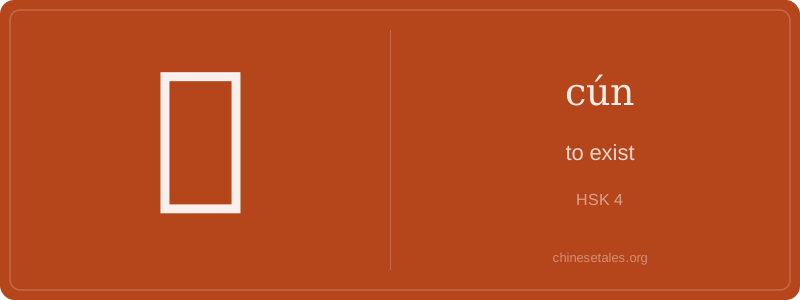
The earliest form of 存 (in bronze inscriptions, c. 1000 BCE) was a combination of a standing human figure (later simplified to the top stroke and dot) above 子 (zǐ, 'child') — not because it meant 'child', but because 子 here served as a phonetic component while also subtly reinforcing the idea of 'continuity through lineage'. Over centuries, the upper part evolved from a stylized person into the current ⺍-like shape (a compressed head-and-arms), and the lower 子 retained its form — six strokes total: the three-stroke top (⺍) plus the three-stroke 子. By the Han dynasty, it had stabilized into today’s elegant balance: presence held gently, like a hand cradling a child.
This visual logic shaped its meaning: to 'hold something safely in one’s care' → 'to keep alive' → 'to persist' → 'to exist'. In the Analects (12.22), Confucius says 君子成人之美,不成人之惡;小人反是 — and commentators later used 存善 to mean 'to nurture goodness within'. The character’s quiet strength — no aggressive radicals, no sharp angles — mirrors its semantic role: not forceful being, but sustained, responsible presence. Even today, when you 存钱 (save money) or 存文件 (save a file), you’re performing the same ancient act: safeguarding what matters.
Think of 存 not just as 'to exist', but as 'to be held in safekeeping' — like something precious preserved across time. Its core feeling is quiet endurance: a memory that persists, a tradition that survives, a bank deposit that remains intact. In classical Chinese, it often carried the nuance of 'to retain' or 'to preserve' (e.g., 存心 'to harbor an intention'), and that sense still lingers in modern usage — you don’t just *exist*; you *endure with purpose*. It’s rarely used alone as a verb in speech ('There exists a problem' → 有问题 exists, but 存在 is preferred); instead, it shines in compounds and formal writing.
Grammatically, 存 appears most often in two key ways: first, in the compound 存在 (cúnzài), meaning 'to exist' — the standard, neutral term for existence (as opposed to more philosophical 有 or poetic 在); second, in resultative or experiential constructions like 存下来 (cún xiàlái, 'to survive/remain') or 存进去 (cún jìnqù, 'to save [data] into'). Learners often mistakenly use 存 alone where 存在 is required — saying *他存* instead of *他存在* sounds like 'He is deposited!' (a banking slip, not a person).
Culturally, 存 echoes China’s deep reverence for continuity: preserving ancestors’ names (存名), historical records (存史), even digital files (存档). A common mistake is over-translating English ‘exist’ directly — while ‘Does God exist?’ is 上帝存在吗?, saying *上帝存吗?* sounds archaic or poetic, like quoting a Tang dynasty poem. Also, note that 存 is never used for temporary presence (‘She’s in the room’ = 她在房间里, not *她存房间里*).