孙
Character Story & Explanation
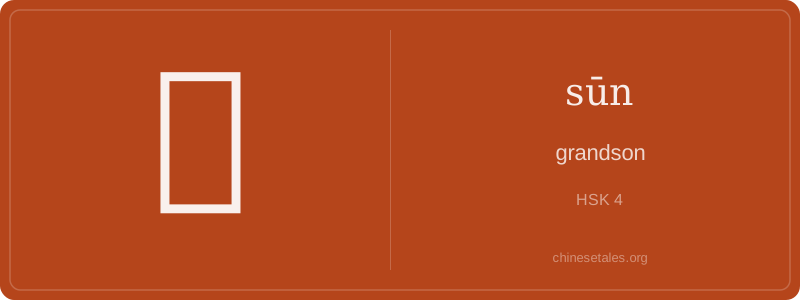
The earliest form of 孙 appears in Warring States bamboo slips — not as a pictograph of a person, but as a clever *semantic compound*. It fused 子 (a stylized infant with large head and limbs) on the left with 小 (three tiny strokes representing smallness) on the right. No ancient oracle bone drawing of a literal 'grandson'; instead, scribes distilled the concept: 'child + small = junior descendant'. Over centuries, the 小 evolved from three distinct dots into today’s compact three-stroke shape — the top dot becoming a short slant, the two lower dots merging into a connected 'v' shape under the horizontal stroke.
This visual logic held firm: the smaller the generation, the further downstream the bloodline. By the Han dynasty, 孙 was standard in texts like the *Book of Rites*, defining kinship rules — e.g., 'a grandson serves his grandfather with reverence equal to his father’s'. The character’s stability is remarkable: unlike many characters that radically simplified, 孙 kept its core structure intact for over 2,000 years, a testament to how perfectly its form captured its meaning — descent measured not by age, but by generational distance.
At its heart, 孙 (sūn) is about lineage — not just 'grandson' as a static label, but the living thread connecting generations. Visually, it’s a masterclass in semantic efficiency: the left side 子 (zǐ, 'child') anchors it firmly in kinship, while the right side 小 (xiǎo, 'small') whispers 'younger, junior, descendant'. This isn’t just biology — in classical Chinese, 孙 could mean *any* male descendant beyond one’s own children (great-grandsons included), and even extended to respectful terms like 孙子 (sūnzi, 'disciple' or 'follower').
Grammatically, 孙 behaves like a noun but carries heavy relational weight. You’ll rarely see it bare: it almost always appears with modifiers — my grandson (我的孙子), her maternal grandfather’s grandson (她外公的孙子), or in compounds like 孙女 (sūnnǚ, 'granddaughter'). A common learner trap? Assuming 孙 means 'son' — no! That’s 儿 (ér). Confusing them turns 'I took my grandson to the park' into 'I took my son to the park' — a generational misstep that’ll raise eyebrows at family dinner.
Culturally, 孙 embodies Confucian filial continuity: the grandson is both heir and caretaker, symbolizing hope, legacy, and duty. In modern usage, it’s also embedded in surnames (e.g., 孙中山 Sūn Zhōngshān, Sun Yat-sen) — where it’s purely phonetic, not familial. That duality (meaningful kinship term vs. sound-based surname element) trips up beginners, so always check context!