Word Explanation
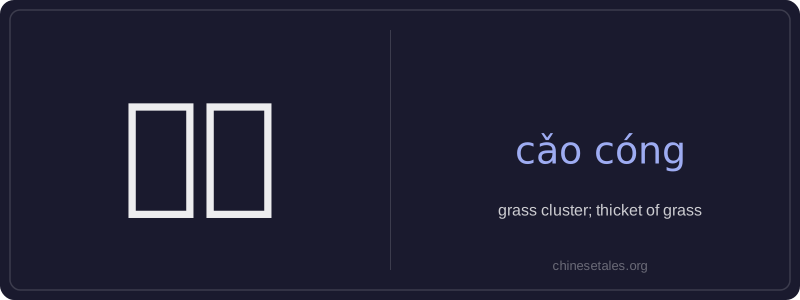
‘草丛’ literally combines 草 (cǎo, 'grass') and 丛 (cóng, 'cluster' or 'thicket'), meaning a dense, natural grouping of grasses or low vegetation. It evokes an image of wild, untended grass growing thickly together — often tall enough to partially conceal small animals or objects. Unlike the more general term 草地 (cǎodì, 'lawn' or 'meadow'), 草丛 suggests irregularity, height, and density, commonly found in fields, forest edges, or abandoned lots.
This word appears frequently in descriptive writing, nature observation, and storytelling — especially when setting a scene where something is hidden, emerging, or moving stealthily. It’s neutral in register and widely used across spoken and written Chinese, though slightly more common in literary or observational contexts than in casual daily speech. The character 丛 always implies multiplicity and closeness, so 草丛 is never used for sparse or mowed grass.
Example Sentences
Related Words
国语
‘Guó yǔ’ literally means 'national language'—
无论谁
‘无论谁’ (wú lùn shéi) is a pronoun meaning
外语
‘外语’ literally means ‘outside language’ —
不对
不对 (bù duì) literally combines 不 (bù), meani
我的
我的 (wǒ de) is a possessive pronoun meaning 'my'
违规
违规 (wéi guī) literally means 'to violate rules
亲笔
‘亲笔’ literally means ‘one’s own hand’—comb
面条
‘面条’ (miàn tiáo) literally means ‘flour str